
版权所有©2022西安交大米兰理工联合学院
Contact:iHarbour,Xi'an,Shaanxi,710049,P.R.China Tel:0089-29-88960094
1. Current Development of the Construction Industry
The construction industry is a major production sector engaged in building construction, equipment installation, and engineering works. Its outputs include factories, mines, bridges, ports, roads, pipelines, residential buildings, public facilities, and other structures and infrastructure. As an important material-producing sector of the national economy, the construction industry is closely connected with national economic development and improvements in people’s living standards. Its rapid growth has created substantial employment opportunities, raised the overall employment rate, and contributed significantly to economic and social development. Since 1978, China’s construction market has continued to expand, and the total output value of the domestic construction industry has increased by more than twenty fold, making the sector an important driver of rapid national economic growth.
With the continued development of China’s economy and society and the growing maturity of modern technologies, the construction industry is gradually transitioning from a labor-intensive industry to a capital-intensive industry. This shift is further accelerating the transformation and upgrading of construction enterprises.
Length of Schooling: Four years or five years
Degrees Conferred: Bachelor of Engineering, Xi’an Jiaotong University (four-year program)
Bachelor of Architecture, Xi’an Jiaotong University (five-year program)
Laurea in Progettazione dell’Architettura (equivalent to a Bachelor of Science in Architectural Design), Politecnico di Milano
2. Industry Development Prospects and Trends
As China pursues high-quality economic and social development, the construction industry is entering a critical period of transformation. As a key contributor to the creation of high-quality human settlements, the sector is displaying several new development trends.
(1) Digitalization and Green, Low-Carbon Development
China has issued a series of policy documents, including the Notice on Issuing a Package of Policies and Measures to Stabilize the Economy, the 14th Five-Year Plan for Renewable Energy Development, and the Implementation Plan for New Urbanization during the 14th Five-Year Plan Period. These policies are guiding the construction sector toward digital, green, and intelligent development. In the field of construction, China is actively promoting green building materials, green construction technologies, and green building products. Energy-conservation and emissions-reduction standards are being applied throughout the entire building life cycle—from the production of building materials and the full construction process to energy conservation and emissions reduction during building operation—thereby fostering a green building ecosystem.
(2) Rural Revitalization
The Rural Revitalization Strategy was proposed by General Secretary Xi Jinping in the report to the 19th National Congress of the Communist Party of China (CPC) on October 18, 2017. The report stated that issues related to agriculture, rural areas, and rural residents are fundamental issues that directly concern the national economy and people’s well-being, and that addressing these issues must always remain the top priority on the Party’s agenda. Under China’s relevant plans, RMB 7 trillion is to be invested in rural development over a five-year period. The development of livable rural communities, cultural and tourism industries, and village conservation will all become important future directions for architecture and the construction industry.
(3) Age-Friendly Community Renovation
As population aging and declining birth rates become increasingly prominent in China, urban and rural areas are paying greater attention to improving the convenience and safety of daily life for older adults by upgrading infrastructure, public services, and residential environments. In terms of physical facilities, priorities include improving accessible routes, installing elevators, adding slip-resistant facilities, and providing age-friendly fitness equipment. At the social-service level, communities are developing eldercare centers, medical stations, and smart eldercare devices to strengthen support for aging in place.
Differences between urban and rural areas also call for targeted measures. Cities focus on installing or upgrading elevators in older residential communities and making public spaces more age-friendly, while rural areas emphasize road paving and improvement, age-friendly renovation of village clinics, and the promotion of mutual-aid eldercare models. These measures are intended to narrow the urban-rural gap in eldercare services and advance the development of communities that are friendly to people of all ages, while also creating new requirements for the development of the architecture and construction sectors.
(4) Urban Renewal
China’s approach to urban development is shifting from extensive outward expansion to the coordinated use and renewal of existing resources. Against the broader background of urban renewal, architecture is showing several interrelated development trends. First, the focus is shifting from the design of individual buildings to systems thinking, with greater emphasis on the coordinated renewal of buildings, urban fabric, and ecological networks. Second, technology-driven green transformation is enabling the sustainable renovation of existing buildings through low-carbon materials, intelligent systems, and resource-regeneration technologies. Third, social value is receiving greater attention, with an emphasis on community participation, the continuity of cultural memory, and the creation of inclusive spaces. Fourth, interdisciplinary integration is accelerating, with tools from data science, sociology, and other fields being applied to complex urban issues. In the future, architecture will place greater emphasis on small-scale renewal and adaptive reuse. In an era centered on existing urban assets, it will need to balance historic conservation, functional revitalization, and spatial justice, and will serve as a key medium for organic urban renewal.
3. History and Overall Strength of the Program
Drawing on Xi’an Jiaotong University’s strengths in engineering, the Architecture program follows the educational philosophy of “solid foundations, strong practical training, and a commitment to innovation.” It is dedicated to cultivating interdisciplinary professionals with strong architectural design capabilities and an understanding of the latest developments in the discipline. The curriculum covers core areas including architectural design, heritage conservation, building technology, and urban design, with particular emphasis on digital design methods such as Building Information Modeling (BIM) and parametric design, as well as green building technologies. Students can strengthen their practical abilities through platforms such as the National Experimental Teaching Demonstration Center for Architecture and joint design workshops, while international exchange programs broaden their global perspectives. Graduates pursue careers in leading design institutes, real estate enterprises, and research institutions, and some continue their studies at renowned universities such as Harvard University and the Massachusetts Institute of Technology. Rooted in the needs of urban and rural development in western China and supported by Xi’an Jiaotong University’s multidisciplinary strengths, the program continues to educate innovative professionals for architecture and the built environment.
The Architecture program at Xi’an Jiaotong University was founded in 1986, and a five-year undergraduate program in Architecture was introduced in 1993. The Department of Architecture was established in 1994 under the then School of Civil Engineering and Mechanics. In 2001, the University was authorized to confer master’s degrees in Architectural Design and Theory, and the first cohort of master’s students was admitted the following year. In 2005, the School of Human Settlements and Civil Engineering was established, comprising the Department of Architecture and three other departments. In 2007, the five-year undergraduate Architecture program passed the national accreditation of architectural education. Students who completed the prescribed courses and credits were therefore eligible for the Bachelor of Architecture degree. In 2008, the program was recognized as a Distinctive Undergraduate Program of Shaanxi Province. In 2010, the University was authorized to confer master’s degrees under the first-level discipline of Architecture. In 2011, the master’s program in Architecture passed the national accreditation of architectural education for the first time, enabling students who completed the prescribed courses and credits to receive the Master of Architecture degree. In 2012, the University was authorized to confer doctoral degrees in the interdisciplinary field of Earth and Human Settlements Science and Engineering.
In 2018, Xi’an Jiaotong University and Politecnico di Milano established a dual master’s degree program in Architecture. In 2019, the Ministry of Education approved their Sino-foreign cooperative master’s education program in Architecture, specializing in the Conservation of Monuments and Sites. The program was selected as a National First-Class Undergraduate Program in 2021. In 2022, Xi’an Jiaotong University began a new phase of international design education in partnership with Politecnico di Milano. In 2024, the University was authorized to confer doctoral degrees under the first-level discipline of Architecture. The undergraduate Architecture program at Xi’an Jiaotong University is currently part of the XJTU-POLIMI Joint School.
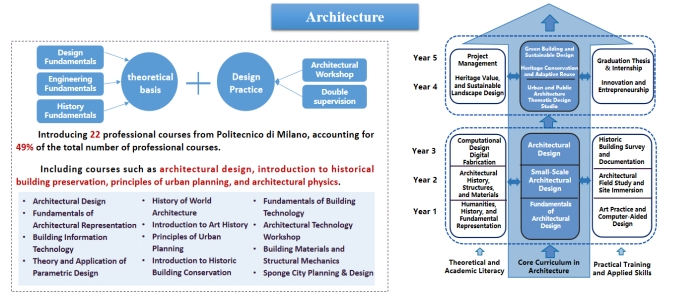
Politecnico di Milano enjoys a distinguished global reputation in Architecture and was ranked 7th worldwide in the 2025 QS World University Rankings by Subject for Architecture and Built Environment. Its Architecture program integrates theory and practice and covers architectural design, heritage conservation, sustainable technologies, urban planning, and related fields. The curriculum emphasizes innovation and interdisciplinary collaboration, and students can participate in international workshops, joint design studios, and projects conducted in cooperation with industry. The University provides advanced laboratories and digital design tools and maintains close links with numerous architecture firms and research institutions. Its graduates work in leading architecture firms or establish their own practices, and distinguished alumni include Pritzker Architecture Prize laureates Aldo Rossi and Renzo Piano. At the XJTU-POLIMI Joint School, core professional courses introduced from Politecnico di Milano account for 72.4% of the professional curriculum. A total of 21 such courses are offered, covering areas including architectural design, fundamentals of architectural representation, and building physics.
Faculty members are jointly selected and appointed by Xi’an Jiaotong University and Politecnico di Milano. The School has also invited distinguished scholars from China and abroad to form an Academic Committee. Drawing on Xi’an Jiaotong University’s strengths in electrical engineering, mechanical engineering, mathematics, physics, and other disciplines, the School appoints outstanding scholars from within and outside the University as faculty members. Politecnico di Milano assigns experienced faculty members and teams of doctoral teaching assistants to deliver more than one-third of the core courses. Together, the two universities provide more than 60 faculty members to support teaching and research activities.
Xi’an Jiaotong University’s Architecture program currently has 39 full-time faculty members, many of whom graduated from renowned universities in China and abroad, including Cornell University, the University of Kitakyushu, Tsinghua University, the University of Hong Kong, and National Cheng Kung University. The overall student-to-faculty ratio is 4:1. Twenty-four faculty members hold the rank of professor or associate professor, accounting for 61.5% of the faculty. Seventy-seven percent hold doctoral degrees, and nearly 70% have studied, worked, or undertaken advanced training for more than one year at leading overseas universities and research institutions, including Columbia University, Cornell University, the University of Tokyo, and Lawrence Berkeley National Laboratory. The faculty team has a well-balanced range of disciplinary backgrounds and academic ranks and has undertaken numerous major national, provincial, and ministerial research projects, as well as real-world architectural and engineering projects. The program also appoints professors, senior architects, and senior engineers from renowned universities and leading architectural design institutes in China and abroad as adjunct faculty members to participate in design teaching.
Positioned at the international frontier of architectural development and grounded in the interdisciplinary framework of “New Engineering, Broad Design, and Emphasis on Interdisciplinarity,” the Architecture program cultivates high-quality interdisciplinary professionals who possess advanced theoretical knowledge and practical design skills. While focusing on the development of students’ architectural design capabilities, the program also places strong emphasis on their innovative practical abilities through interdisciplinary integration, as well as their humanistic literacy, international perspective, and leadership.
In terms of holistic development, the program seeks to cultivate students with a strong sense of social responsibility, the courage to confront difficulties and assume responsibility, a truth-seeking and innovative spirit grounded in facts, and sound character. Professionally, it prepares students to meet the needs of China’s socioeconomic development and urban-rural construction. Students are expected to understand the fundamental concepts of human settlements science and sustainable development; master the basic theories, knowledge, and design methods of Architecture; receive foundational professional training as architects; and develop strong architectural design and practical capabilities. With an innovative spirit and cultural and artistic literacy, graduates will be able to undertake design and planning, project programming and consulting, management and development, teaching, and research in the fields of architecture and urban development, and to grow into leading professionals who play key roles in their organizations.
Five-Year Program
The five-year program requires a total of 191.5 credits. It emphasizes the support that theory and practice provide for design and reinforces the central role of the design studio sequence as the main vertical thread of the curriculum. Professional study is organized within a “one vertical thread and three axes” framework and divided into three stages following a “2+1+2” structure. The first two academic years constitute the foundational stage, focusing on disciplinary orientation and basic training. The second stage, corresponding to the third year, consolidates professional knowledge and places greater emphasis on developing students’ innovative and research capabilities. The third stage, corresponding to the fourth and fifth years, expands professional competence and strengthens integrated practical abilities.
The program actively explores diverse teaching methods under the Outcomes-Based Education (OBE) framework. Digital simulation and site-based practical teaching are incorporated into the core design studios as new teaching approaches. They address the limitations of conventional two-dimensional drawings, hand-built models, and computer-generated 3D models, which cannot fully provide a sense or experience of real spatial scale. The program also moves beyond a single-instructor teaching model by introducing a wider range of participants into the teaching process.
Four-Year Program
The four-year program requires a total of 156 credits. Its curriculum is organized around the development of design abilities within a broad conception of Architecture. Beginning with Fundamentals of Architectural Design in the first year, progressing to Architectural Design I and II in the second year, and continuing in the upper years with thematic design studios such as Neighborhood and Public Building Design, Architectural Design III, and Urban and Public Building Design, the curriculum forms a complete sequence from foundational to integrated training and from architecture to urban and rural environments.
Core professional courses are co-taught by Chinese and Italian faculty members. While cultivating students’ international perspective and professional competence, the curriculum emphasizes the close integration of theory and practice. Courses related to digital and intelligent design include Computer-Aided Architectural Design, Building Technology Workshop, and Artificial Intelligence in Architectural and Urban Design. These are complemented by broad foundational courses in architectural history and theory, low-carbon architecture, and the principles of landscape architecture and planning, as well as a diverse range of professional electives that support individualized development and interdisciplinary exploration. Concentrated practical training includes architectural model making, art practice, introductory architectural fieldwork, introductory urban fieldwork, measured drawing of historic buildings, professional practice in architecture, and graduation design. Together, these components strengthen students’ hands-on abilities and professional competencies.
The Architecture program at Xi’an Jiaotong University is committed to developing distinctive educational platforms and places strong emphasis on practical teaching. For academic exchange, the program organizes activities such as the “Design Future” academic salon series and the “Innovation · Future” seminar series. These events break down disciplinary boundaries, promote academic exchange across multiple fields, and broaden students’ perspectives. Through the “XJTU-POLIMI Tea Talks,” students can communicate informally with faculty members over lunch or afternoon tea, creating a relaxed environment for dialogue between teachers and students.
The program provides diverse practice platforms. It has established off-campus practical teaching bases with organizations such as the China Northwest Architecture Design and Research Institute Co., Ltd. and the Daming Palace Heritage Museum, enabling students to engage with real projects and accumulate experience. Cooperation with professional institutions, including Shanghai HYP-ARCH Architectural Design Consultant Co., Ltd., further strengthens students’ professional design capabilities. The program also uses platforms such as the Design Sub-Alliance of the University Alliance of the Silk Road to expand students’ international perspectives. Under a coordinated academic- and residential-college education model, the School organizes activities in Party and Youth League development, cultural and creative design, sports, and cultural sharing to enhance students’ comprehensive qualities. Through these wide-ranging educational platforms, Architecture students grow through practice and build a strong foundation for their future careers.
To date, students have received more than 40 national-level awards and more than 80 provincial and ministerial-level awards. Five faculty-student teams have received a total of five honors in major international design awards: four iF Design Awards and one Red Dot Design Award. Five project teams have received Gold Awards in the International Track of the China International College Students’ “Internet+” Innovation and Entrepreneurship Competition, with faculty members from both universities serving jointly as advisors for every project. One project reached the global top eight of the James Dyson Award. One student team received a Finalist Award in the 2023 Mathematical Contest in Modeling/Interdisciplinary Contest in Modeling (MCM/ICM), and one student won a Gold Medal at the Hangzhou Regional Contest of the International Collegiate Programming Contest (ICPC). Two students received, respectively, the Grand Prize—the only Grand Prize awarded in Shaanxi Province—and First Prize—one of only three First Prizes awarded in the province—in the Shaanxi Provincial Foreign-Language Speech Contest for Students in Sino-Foreign Cooperative Education Programs.
Architecture is one of the largest disciplinary fields within the construction sector. Its importance has long been widely recognized, and it has traditionally been one of the university majors with relatively strong employment prospects. The main career pathways for Architecture graduates include the following:
• Architectural design and research institutes, Chinese and international architecture firms, and urban and rural planning and design institutes, where graduates engage primarily in architectural design and related research, with growing emphasis on BIM, green building, and other professional technologies.
• Government departments such as housing and urban-rural development authorities and planning bureaus, where graduates may work in construction-sector administration, urban management, building quality inspection, and historic building conservation.
• Real estate development enterprises, where graduates work in project planning and development, design coordination, and management.
• Universities and research institutions, where graduates teach or conduct research in architectural design and theory.
• Other design-related fields, including rail transit design institutes, electric power design institutes, interior design companies, advertising design firms, and planning consultancies.
Among undergraduate graduates of the past three years, nearly 51% have either been recommended for postgraduate admission without examination or gained admission to postgraduate programs in China, while approximately 21% have chosen to pursue further study overseas. Overseas destinations include Harvard University, the Massachusetts Institute of Technology, Columbia University, Cornell University, the University of California, Los Angeles, and University College London. Graduates are employed mainly by architectural design and research institutes, Chinese and international architecture firms, urban and rural planning and design institutes, urban construction authorities, and real estate development companies in large and medium-sized cities, where they undertake work in planning and design, project programming and development, and management.
Q: What does Architecture study?
Architecture is the discipline concerned with buildings and their environments. The primary objective of an Architecture program is to prepare students for architectural design and to enable them to create high-quality architectural spaces and environments for users.
Architecture is a highly comprehensive discipline characterized by the integration of science and art, engineering and the humanities. Its subject matter generally includes both technical and artistic dimensions. Building technology addresses issues such as structural stability and safety, indoor environmental comfort, and energy efficiency. Students may explore, for example, how high-rise buildings or sports venues are structurally supported, how building-envelope walls provide thermal insulation, and what technical measures can be adopted to create green buildings. The artistic dimension of architecture aims to create aesthetically compelling building forms and architectural spaces that provide spiritual and emotional enrichment. Through different design methods, architects can shape the solemn and monumental, welcoming and comfortable, quiet and elegant, or bright and open atmospheres required by different building types, evoking feelings such as respect, warmth, relaxation, and enjoyment.
The Architecture curriculum covers the theories and methods of architectural design, architectural history and theory, building technology, urban planning, and landscape design, together with skills in drawing, model making, and integrated presentation and communication. Architectural design requires attention to a wide range of considerations: from functional requirements to aesthetic quality, from cultural meaning to behavioral psychology, and from structural arrangement to material selection and building-services configuration, as well as construction costs and market demand. Architectural proposals do not emerge from imagination alone; inspiration may come from history, culture, society, nature, and the urban environment. Architecture therefore encompasses an exceptionally broad body of knowledge.
Q: What qualities and abilities are helpful for Architecture students? Is this program right for me?
Students entering Architecture benefit from some experience in drawing and an appreciation of art, as well as spatial imagination, hands-on ability, strong communication skills, perseverance, and a willingness to work hard. These qualities and abilities, however, are also progressively developed and strengthened through university study. Architecture requires a way of thinking that combines rational analysis with creative enthusiasm, a broad range of knowledge and cultural literacy, and the ability to act rigorously and logically while maintaining an understanding of the whole.
A strong aesthetic sensibility is helpful, but it does not have to be acquired only through formal drawing practice. Photography, film, music, exhibitions, works of art, and attentive travel can all cultivate aesthetic awareness. The ability to discover beauty in different objects and media begins with curiosity about life and the world and with a willingness to observe one’s surroundings carefully.
The purpose of art education in Architecture is not to train painters. It is to develop sensitivity to form and space, the ability to communicate those perceptions through drawing, and coordination among the eye, mind, and hand.
In simple terms, students who enjoy creative activities such as drawing, making objects, or designing; who are curious about new things; who like developing ideas; and who wish to transform those ideas into reality are well suited to the field.
Q: Does a background in drawing provide an advantage? Will students without such experience be disadvantaged?
A background in drawing can provide an initial advantage in Architecture, particularly in rapidly communicating design ideas, developing spatial perception, and adapting to early hand-drawing courses. Drawing ability, however, is not a decisive factor. Architecture places greater emphasis on comprehensive abilities, including logical thinking, spatial imagination, technical knowledge, and the use of digital tools. Students without prior drawing experience can develop the necessary skills through systematic training in sketching and perspective, as well as through digital tools such as modeling software. Many outstanding architects began without formal drawing experience. Drawing is therefore an advantage rather than a prerequisite. The Architecture program at Xi’an Jiaotong University does not require applicants to have a drawing background; interest, sustained effort, and continuous learning are far more important.
Q: I hope to study at Xi’an Jiaotong University. What is the difference between Architecture and Civil Engineering?
Architecture and Civil Engineering are closely related but distinct disciplines. In terms of the professionals they prepare, architects are responsible for a building’s external form, functional organization, and the detailed treatment of its spatial design. Put simply, they seek to make buildings both attractive and practical. Structural engineers are the architects’ partners. Their task is to ensure that the buildings conceived by architects can stand safely, carry the loads imposed during use, and resist wind, snow, earthquakes, and other forces within specified limits. For the CCTV Headquarters, for example, the architect considered the building’s distinctive form and the operational requirements of China Central Television, while the structural engineer determined the structural system, materials, dimensions of beams and columns, and connection methods required to keep the building stable. In architectural design organizations, architects generally lead the overall design process while coordinating closely with structural and building-services engineers.
Architecture students learn foundational concepts from Civil Engineering, including architectural mechanics and structural principles. Beyond this technical foundation, Architecture places substantial emphasis on artistic judgment, historical and cultural literacy, and the theories and methods of architectural design. Its aim is to integrate artistic and rational inquiry, enabling students to express original ideas through a broad range of artistic and technical means while meeting users’ functional needs.
Q: How does the Architecture program at the XJTU-POLIMI Joint School differ from the Architecture program in the University’s School of Human Settlements and Civil Engineering and from programs at other Project 985 universities? What are its advantages?
The Architecture program at the XJTU-POLIMI Joint School has the following distinctive features:
International dual-degree education: The program is jointly delivered with Politecnico di Milano, whose Architecture discipline ranks among the world’s top ten in the QS subject rankings. Graduates receive degrees from both the Chinese and Italian partner universities, and the curriculum integrates European design methodologies with Chinese professional practice.
Teaching approach: Approximately one-third of the courses are delivered in English. The program emphasizes innovative design and digital technologies, and its teaching team includes faculty members from both universities, with strong attention to cultural exchange and the development of an international perspective.
Practice opportunities: Students participate in international joint workshops and international competitions; students from the XJTU-POLIMI Joint School participate with international-student status.
Interdisciplinary integration: The program offers broader opportunities for collaboration with the humanities and arts, Industrial Design, Mechanical Engineering, and other disciplines.
The Architecture program in the School of Human Settlements has the following characteristics:
Depth of local professional training: Its curriculum places greater emphasis on Chinese building codes, green building technologies, and design rooted in regional culture.
Engineering-based interdisciplinarity: Drawing on the School’s strengths in engineering, it offers multiple interdisciplinary courses with Civil Engineering, Environmental Engineering, and related fields.
Other Project 985 universities have their own established strengths. Tsinghua University and Tongji University are known for their long histories in traditional architectural education and extensive industry resources; Southeast University places particular emphasis on tectonics and construction technology; and Tianjin University has strong expertise in architectural history and theory. The distinctive advantage of the XJTU-POLIMI program lies in its combined emphasis on internationalization and digitalization.
Q: China’s real estate market is currently weak, and many design institutes have closed. Will I still be able to find a job after studying Architecture?
The industry is indeed experiencing a decline in demand for conventional residential design. At the same time, demand is rising in emerging areas such as urban renewal, smart cities, low-carbon architecture, age-friendly renovation, heritage conservation, and whole-life-cycle design. In 2023, the Ministry of Housing and Urban-Rural Development stated that the urban renewal market during the 14th Five-Year Plan period would exceed RMB 10 trillion.
Employment pathways for Architecture graduates are becoming increasingly diverse. Non-traditional roles include overall project coordination and leadership, as distinct from conventional engineering-led project management; renewable-energy building consulting, such as building-integrated photovoltaics (BIPV); digital-twin modeling; game-environment design; and exhibition planning. Areas with relatively stable demand include state-owned design institutes undertaking government-funded public building projects; overseas infrastructure projects under the Belt and Road Initiative that require professionals familiar with Chinese standards; and emerging fields such as project programming, project evaluation, and project operation and maintenance.
Under these new conditions, students are advised to develop proficiency in digital tools, sustainable design, early-stage project programming, and knowledge of post-completion operation and management in order to strengthen their core competitiveness.
Q: What are the core courses in Architecture?
The core course sequence includes Fundamentals of Architectural Design, Architectural Design, and Graduation Design, running from the first through the fourth year.
Major supporting courses include architectural history and theory, including the History of Chinese Architecture and the History of Foreign Architecture; Urban Design; Landscape Design; Environmental Psychology; Building Construction; Building Physics, covering acoustics, lighting, and thermal environments; and Structural System Selection.
Tool-oriented courses include Architectural Drawing and Parametric Design, together with other broad foundational courses and professional electives. The Architecture curriculum at the XJTU-POLIMI Joint School also includes distinctive content in Italian architectural history and art history.
Q: What are the distinctive educational features of the Architecture program?
Architecture education in the new era places increasing emphasis on interdisciplinary integration, sustainable development, and digital innovation. It seeks to cultivate interdisciplinary professionals capable of balancing globalization and regional identity, as well as humanistic concern and ecological responsibility. The curriculum incorporates emerging areas such as green building, heritage conservation, intelligent construction, and parametric design, and uses tools including BIM, artificial intelligence, and virtual reality to improve design efficiency and precision. Teaching promotes collaboration among education, industry, and research through real-world projects, international workshops, and other practical components. These experiences develop students’ critical thinking, climate-responsive design capabilities, and awareness of social participation. Students are also encouraged to connect architectural inquiry with contemporary issues such as urban renewal and rural revitalization, enabling them to respond to the multidimensional challenges of future human settlements.
Q: What kinds of growth and training can I gain from studying Architecture?
Studying Architecture develops a wide range of professional abilities and transferable skills. Professionally, students systematically learn architectural design principles, methods of spatial composition, and techniques of architectural representation. They develop strong abilities in formal composition and innovative thinking and learn to transform abstract concepts into concrete architectural proposals.
At the technical level, students study architectural structures, materials, construction, and other engineering and technical knowledge and become proficient in professional software such as CAD and BIM. This enables them to translate design proposals into technically feasible and implementable solutions.
In terms of intellectual development, extensive design practice helps students develop systematic design thinking. They learn to consider function, form, technology, economics, and other factors in an integrated manner and to solve complex problems. Architecture education also strengthens aesthetic literacy, historical awareness, and cultural understanding, enabling students to create designs that combine artistic quality with humanistic concern.
Through field research, model making, teamwork, and related exercises, students improve their communication and coordination, project management, and implementation abilities. The study of Architecture further develops observation, spatial imagination, continuous learning, and resilience under pressure. These comprehensive qualities provide graduates with greater adaptability and competitiveness in their future careers.
Q: What is the most difficult part of studying Architecture, and what is the most attractive part?
The greatest challenge of studying Architecture lies in its interdisciplinary complexity. Students need rational thinking to understand structures, technologies, materials, and other engineering knowledge, while also developing the artistic sensitivity required to shape spatial aesthetics and cultural meaning. At the same time, they must learn to balance these considerations within real constraints such as limited budgets, regulations, and construction conditions.
The most compelling aspect of Architecture is the materialization of creativity: abstract concepts can be transformed into physical spaces that people can enter and experience, and design can directly influence people’s quality of life and emotions. When architectural drawings created by one’s own hand eventually become buildings standing in the real world, the resulting sense of achievement—combining artistic value and social significance—is difficult to replace.
Q: Where do Architecture graduates work?
Under changing industry conditions, Architecture graduates are pursuing increasingly diverse career paths. Traditional design institutes, architecture firms, and the real estate sector remain important choices, but industry restructuring has also led some graduates toward infrastructure development, urban renewal, green building, carbon-neutral development, and other emerging fields. Digital transformation is creating opportunities in architectural technology, including BIM and smart-city applications; virtual and augmented reality design; and internet platforms related to home and spatial design.
Other graduates enter public service in planning and housing and urban-rural development departments, move into game-environment design, exhibition planning, education, or entrepreneurship. These trends reflect growing demand for interdisciplinary professionals. Overall, career development is expanding from a single focus on architectural design toward integrated professional pathways combining technology, management, and innovation.
Q: Does the Architecture program offer international cooperation projects or exchange opportunities?
Through intergovernmental cooperation programs and exchanges among experts, faculty members from Xi’an Jiaotong University and Politecnico di Milano have jointly undertaken a number of international cooperation projects. One example is the “Sino-Italian Joint Laboratory for Sustainable Urban and Rural Heritage Conservation and Regeneration,” a project supported by the National Key R&D Program of China under the key special program for Intergovernmental International Science and Technology Innovation Cooperation. Supported by these projects, many students have taken responsibility for or participated in undergraduate innovation and entrepreneurship projects.
Xi’an Jiaotong University and Politecnico di Milano have also signed a student exchange agreement. Each year, approximately 20 interested second-year Architecture students are selected to attend a summer study program at Politecnico di Milano. Students may additionally participate in credit-exchange and summer programs between Xi’an Jiaotong University and more than 300 universities worldwide. To date, 135 students have attended summer programs at institutions including the University of Oxford, the University of Cambridge, Imperial College London, the Royal College of Art, and the National University of Singapore.
Q: Which well-known professors teach Architecture at Xi’an Jiaotong University, and what roles will they play in my university experience?
The Architecture program at Xi’an Jiaotong University has a number of highly regarded and dedicated professors whose work covers cultural heritage conservation and regeneration, green building and sustainable design, architectural history and theory, and digital architectural design. They play multiple roles in students’ university experience. As academic mentors, they help students establish solid disciplinary foundations and broaden their understanding of emerging fields through rigorous teaching and research guidance. As guides to professional practice, they lead students in real projects and competitions, cultivating innovation and problem-solving abilities. They also serve as role models for career development, inspiring students through their academic achievements and professional influence. Some professors work closely with students through studios and research groups, providing individualized support in academic exploration, career planning, and personal development, and becoming important mentors throughout their university years.
Q: Who are some distinguished alumni of the Architecture program, and can current students receive support from them?
The Architecture program at Xi’an Jiaotong University has educated many distinguished alumni, including Gao Qinghui, Chief Architect of the Architects & Engineers Co., Ltd. of Southeast University; Kou Hang, Chief Architect of Arcplus Group; and Lu Peng, Director of an Architectural Design Department at China Architecture Design & Research Group. They have made important contributions to architectural design, academic research, urban renewal, and related fields.
Current students can receive support from alumni through forums, professional lectures, and practice-based collaboration. Alumni are frequently invited back to campus to share industry experience, participate in design reviews, and provide internship opportunities. Some alumni also establish scholarships or collaborate on research projects, helping students build professional networks. The University actively coordinates alumni resources through mentorship programs and university-enterprise cooperation, providing students with career guidance and practical opportunities.
Q: What is the difference between the five-year and four-year Architecture programs?
The four-year program retains the central role of the architectural design studio sequence while reducing the total number of credits and shortening the period of study by one year. Students admitted in 2025 or earlier follow the five-year curriculum, while those admitted in 2026 or later follow the four-year curriculum. The degree awarded by Xi’an Jiaotong University changes from the Bachelor of Architecture to the Bachelor of Engineering, while the Laurea in Progettazione dell’Architettura (equivalent to a Bachelor of Science in Architectural Design) awarded by Politecnico di Milano remains unchanged.
Friendship Link :
西安交通大学