
版权所有©2022西安交大米兰理工联合学院
Contact:iHarbour,Xi'an,Shaanxi,710049,P.R.China Tel:0089-29-88960094

1. Industry Information and Future Prospects
The Intelligent Manufacturing Engineering program focuses on the multidisciplinary integration required by Industry 4.0 and responds to the development trends of the Fourth Industrial Revolution. Breaking away from conventional models of disciplinary education and established path dependence, the program is built primarily on the disciplinary strengths of Xi’an Jiaotong University and Politecnico di Milano in Mechanical Engineering, while integrating related fields such as information and communications technology, computer science, and industrial engineering. It aims to cultivate professionally competent, innovative, and top-tier engineering and technology professionals who possess a global perspective, systems-thinking capabilities, and the ability to integrate knowledge across disciplinary boundaries, and who can adapt to the emerging forms of intelligent manufacturing in the future.
Mechanical Engineering at Xi’an Jiaotong University, the principal Chinese supporting discipline for the program, was among the first group of National Key First-Level Disciplines and is included in the Ministry of Education’s Double First-Class Initiative. It ranks in the leading tier in the latest national discipline evaluation and is also among the world’s leading Mechanical Engineering disciplines in major international university rankings. The discipline has established 24 national, provincial, and ministerial-level research bases, including the National Key Laboratory for Precision Micro-Nano Manufacturing Technology and the 2011 Collaborative Innovation Center for High-End Manufacturing Equipment. It also operates two National Experimental Teaching Demonstration Centers: the National Experimental Teaching Demonstration Center for Fundamentals of Mechanical Engineering and the National Experimental Teaching Demonstration Center for Mechanical Engineering. At the Xingqing Campus and the Western China Science and Technology Innovation Harbour, the discipline has developed an integrated virtual-physical practical teaching platform for intelligent manufacturing that supports off-site and remote interaction, providing strong support for the education of intelligent manufacturing professionals.
Mechanical Engineering at Politecnico di Milano, the principal international supporting discipline for the program, enjoys a distinguished global reputation. It maintains close links with high-end manufacturing sectors such as automotive engineering, energy, and aerospace, and offers intelligent-manufacturing-related areas including advanced power systems, mechanical systems design, production engineering, and mechatronics. Through the tradition of “Italian design,” the discipline strengthens the innovativeness, aesthetic quality, functionality, and manufacturability of products and holds world-leading positions in renewable energy, robotics, and networked collaborative manufacturing. It places great emphasis on talent cultivation and on integrating theoretical foundations with engineering practice. A large number of courses include practice-based projects designed to strengthen students’ ability to solve real-world engineering problems.
The program strengthens educational innovation and Sino-foreign cooperative education in response to the growing STEAM orientation of global engineering education—the integration of science, technology, engineering, arts, and mathematics. It upholds the educational philosophy of “solid foundations, rigorous standards, strong practical training, and a commitment to innovation,” optimizes an Outcomes-Based Education (OBE)-oriented talent cultivation system and model, and cultivates future leaders in intelligent manufacturing with a global perspective.
2. History and Overall Strength of the Program
The Mechanical Engineering discipline at Xi’an Jiaotong University was founded in 1913 and is one of the earliest-established and strongest Mechanical Engineering disciplines in Chinese higher education. It was selected in 2007 as one of the first National Key First-Level Disciplines and was included in the list of World-Class Disciplines in 2017. It is rated A+ in the Ministry of Education’s national discipline evaluation, ranks first globally in U.S. News, and is among the top 0.1% of disciplines worldwide in the Essential Science Indicators (ESI). The Intelligent Manufacturing Engineering program is supported by the Mechanical Engineering discipline. Rooted in conventional Mechanical Engineering, it deeply integrates knowledge from computer science, automation, materials science, artificial intelligence, industrial management, and related fields. The program is characterized by the interdisciplinary integration of information and communications technology, computer science, and industrial engineering, and incorporates a new generation of information technologies, including digital twins, big data, cloud computing, virtual reality, the Internet, and the Internet of Things. It has established a complete education system spanning innovative design, intelligent production, systems integration, and intelligent operation and maintenance. The program cultivates broad-based, interdisciplinary, innovative, and top-tier engineering and technology professionals with international competitiveness who are capable of designing, building, and managing the intelligent factories and intelligent products of the future.
The Mechanical Engineering discipline at Xi’an Jiaotong University is rated A+, ranks first globally in U.S. News, and is included in the national list of disciplines under the Double First-Class Initiative. Supported by this discipline and oriented toward the strategic need to build China into a manufacturing powerhouse, the Intelligent Manufacturing Engineering program is distinguished by its interdisciplinary integration of information and communications technology, computer science, industrial engineering, and related fields. It introduces new-generation information technologies such as digital twins, big data, cloud computing, virtual reality, the Internet, and the Internet of Things, and has developed a complete curriculum and practice platform covering innovative design, intelligent production, systems integration, and intelligent operation and maintenance. It is committed to cultivating innovative and top-tier engineering and technology professionals with systems thinking and the ability to integrate knowledge across disciplinary boundaries.
Mechanical, Aeronautical and Manufacturing Engineering at Politecnico di Milano was ranked 12th worldwide in the 2025 QS World University Rankings by Subject. Addressing high-end manufacturing and industrial digital transformation and upgrading, the discipline has outstanding research and development strengths in intelligent manufacturing, industrial robotics, advanced manufacturing processes, and intelligent operation, maintenance, and services. The Joint School has introduced 20 specialized courses from Politecnico di Milano, which account for 57.14% of the core curriculum. These courses include Fundamentals of Artificial Intelligence, Fundamentals of Finite Element Simulation in Engineering, Introduction to Intelligent Sensing and the Industrial Internet of Things, Intelligent Manufacturing Systems Engineering, Fundamentals of Industrial Robotics, and Cyber-Physical Manufacturing Systems and Practice, for a total of 20 courses.
3. Length of Schooling and Degrees Conferred
Length of Schooling: Four years
Degrees Conferred: Bachelor of Engineering, Xi’an Jiaotong University
Laurea in Ingegneria Meccanica (equivalent to a Bachelor of Science in Mechanical Engineering), Politecnico di Milano
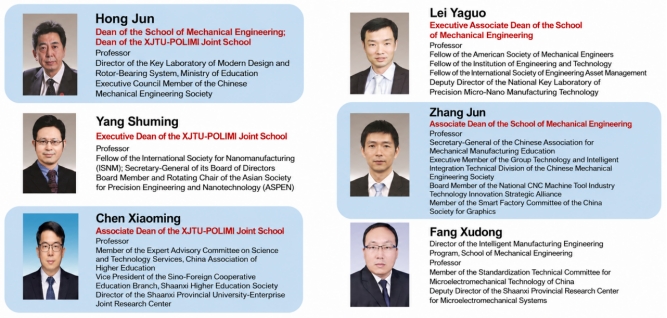
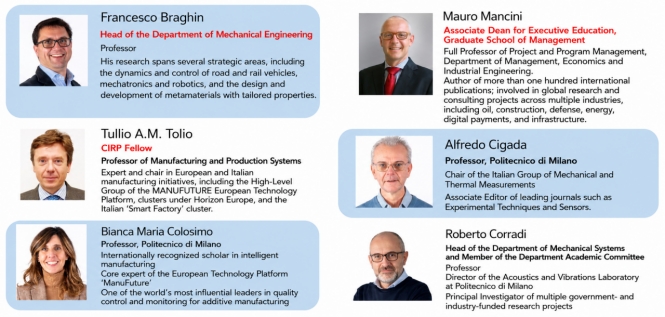
Faculty members are jointly selected and appointed by Xi’an Jiaotong University and Politecnico di Milano, and distinguished scholars from China and abroad are invited to form an Academic Committee. Drawing on Xi’an Jiaotong University’s strengths in Mechanical Engineering, Artificial Intelligence, Automation, Computer Science, Industrial Engineering, and related disciplines, the Joint School appoints outstanding scholars from within and outside the University as faculty members. Politecnico di Milano assigns experienced faculty members and teams of doctoral teaching assistants to deliver more than one-third of the core courses. Together, the two universities provide more than 30 faculty members to support teaching and research activities.
Graduates of this program are expected to possess “first-rate character” and a set of personal values centered on diligence, earnestness, fortitude, loyalty, and consideration for others. They should have a strong understanding of the social dimensions of engineering, systems-oriented engineering thinking, engineering ethics, and a global perspective. They should master broad and solid scientific and engineering foundations, together with specialized knowledge covering the full product life cycle, including intelligent design, intelligent production, and intelligent operation and maintenance. In positions related to product development, technological research and development, production management, and scientific research in intelligent manufacturing and related fields, graduates should be able to apply big data, artificial intelligence, cloud computing, and other technologies comprehensively and innovatively. They should also be able to integrate non-technical considerations relating to society, law, safety, culture, and the environment, solve complex engineering problems effectively, continuously renew and develop themselves, and demonstrate the potential to become leading professionals in modern engineering and technology.
Within approximately five years after graduation, graduates are expected to have developed the following capabilities through continued learning and professional practice:
Objective 1: Possess a solid foundation in mathematics, the natural sciences, and engineering; master systematic professional knowledge in intelligent manufacturing; and comprehensively apply big data, artificial intelligence, cloud computing, and related methods to complex product development and the operation of production systems.
Objective 2: Coordinate technical and non-technical factors and possess the analytical, practical, and innovative capabilities needed to solve complex engineering problems involving intelligent products and production systems from global and systems-oriented perspectives, together with the ability to operate and manage engineering projects.
Objective 3: Demonstrate strong teamwork and communication abilities, a global perspective, and the capacity for cross-cultural communication, competition, and cooperation.
Objective 4: Possess sound moral character and professional ethics; understand the laws, regulations, policies, standards, and principles of sustainable development relevant to the intelligent engineering profession and industry; embrace the values of modern industrial society; and demonstrate a strong sense of social and professional responsibility.
Objective 5: Possess critical thinking, a commitment to lifelong learning, and the ability to pursue further education and continuous improvement; understand the impact of broad technological change on engineering and society; and adapt to the development and evolution of new technologies and ideas.
The curriculum is designed around the objective of cultivating interdisciplinary, internationally oriented, and outstanding professionals in Intelligent Manufacturing Engineering. Drawing on the complementary disciplinary strengths of Xi’an Jiaotong University and Politecnico di Milano, it establishes an interdisciplinary, frontier-oriented, and continuously updated education plan. The strengths of the faculty teams from both universities are combined to build a high-level professional teaching team. High-standard experimental content and laboratory planning and development demonstrate the quality and effectiveness of practice-based education. By introducing industrial resources and research needs, the program improves both curriculum-based and practice-based education and strengthens the integration of industry and education.
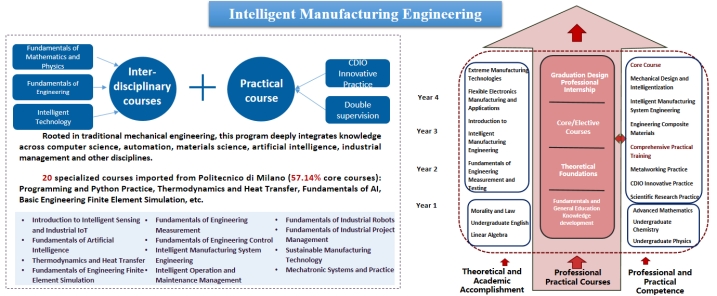
The program’s educational platforms include leading teaching and research facilities such as the National Key Laboratory for Precision Micro-Nano Manufacturing Technology, the National Experimental Teaching Demonstration Center for Fundamentals of Mechanical Engineering at Xi’an Jiaotong University, and the National Experimental Teaching Demonstration Center for Mechanical Engineering. It also has more than 40 university-enterprise joint platforms established with organizations such as China General Technology Group, CHN Energy, and the National Innovation Center for Additive Manufacturing, together with dozens of international practice bases for the integration of industry and education. Through interdisciplinary coursework, Sino-foreign cooperation in industry-education integration, and comprehensive training that brings real corporate design projects into classroom-based design practice, the program provides students with a high-quality, full-chain teaching platform encompassing in-class experiments, extracurricular practice, competition-based training, and hands-on research experience.
Q: What does Intelligent Manufacturing study?
Intelligent Manufacturing primarily studies how advanced information technologies, automation technologies, and intelligent methods can be used to enable manufacturing systems to perceive, make decisions, execute tasks, and optimize themselves autonomously, thereby improving production efficiency, flexibility, quality, and intelligence. Its principal research areas include the following:
Intelligent equipment and robotics: Developing CNC machine tools, industrial robots, automated guided vehicles (AGVs), 3D printers, and other equipment with sensing, adaptive, and collaborative capabilities.
Digital design and manufacturing: Studying digital modeling technologies across the product life cycle, including CAD, CAE, and CAM, as well as virtual simulation and digital twins.
Intelligent sensing and control: Using sensors, the Internet of Things (IoT), machine vision, and related technologies to collect manufacturing-process data in real time and implement closed-loop intelligent control.
Manufacturing big-data analytics: Applying big data and artificial intelligence, including machine learning and deep learning, to mine production data for predictive maintenance, quality traceability, process optimization, and related purposes.
Smart factories and systems integration: Studying flexible production lines, smart workshop layout, Manufacturing Execution Systems (MES), Enterprise Resource Planning (ERP), and the integration and coordination of industrial Internet platforms.
Human-machine collaboration and new intelligent-manufacturing models: Exploring human-in-the-loop intelligent systems, AR/VR-assisted assembly, human-robot collaboration, mass customization, cloud manufacturing, and other emerging manufacturing models.
Q: What are the core courses in Intelligent Manufacturing Engineering?
As a typical interdisciplinary field, Intelligent Manufacturing Engineering generally integrates four major areas: Mechanical Engineering, Control Engineering, Computer Science, and Industrial Engineering. The core courses in Xi’an Jiaotong University’s Intelligent Manufacturing Engineering program include:
Fundamentals of Artificial Intelligence
Big Data Technologies
Mechanical Design and Intelligent Technologies
Intelligent Manufacturing Processes and Equipment
The program also offers a rich range of integrated practical training courses, including:
CDIO Projects
In-Class Experiments
Extracurricular Practice
Disciplinary Competitions and Research Training
Q: Where do graduates of Intelligent Manufacturing Engineering work?
Intelligent Manufacturing Engineering is a typical interdisciplinary New Engineering major with a wide range of career opportunities. Graduates may work directly in manufacturing operations or pursue careers in industrial software and digital transformation. The main career pathways include the following:
High-end manufacturing and equipment enterprises: These include industries such as automobiles, represented by companies such as BYD and Geely; new energy, represented by CATL; aerospace; construction machinery, represented by SANY Heavy Industry; and electronics and semiconductors. Graduates may work in intelligent production-line planning, industrial robot commissioning and application, CNC equipment research and development, and intelligent production-line operation and maintenance.
Industrial software and corporate digitalization departments: Graduates may join industrial software companies, such as Siemens, Yonyou, and Huawei, or the digitalization departments of major manufacturing enterprises. Positions include MES/ERP implementation consultant, industrial application development engineer, industrial big-data analyst, and digital-twin engineer. Their work involves building the factory’s “digital nervous system” and extracting value from industrial data.
Systems integrators and solution providers: Graduates may work for intelligent manufacturing systems integrators or consulting firms, including institutes affiliated with China Electronics Technology Group Corporation and various automation integrators. Their responsibilities may include intelligent manufacturing solution architecture, systems integration and delivery, and top-level smart-factory design, helping traditional factories implement intelligent transformation.
Research institutes and government organizations: Graduates may join the China Academy of Machinery Science and Technology, local intelligent manufacturing research institutes, bureaus of industry and information technology, administrative committees of high-tech development zones, and related organizations, working in technological research and development, policy research, standards development, or industrial administration.
Further study: Many graduates choose postgraduate study through recommendation without examination or the national postgraduate entrance examination. Common fields include Intelligent Manufacturing, Mechanical Engineering, Control Science and Engineering, Robotics, and Industrial Engineering, leading to more advanced research and development or academic careers.
Overall, Intelligent Manufacturing Engineering is an interdisciplinary program. Employers particularly value professionals who understand manufacturing processes while also possessing knowledge of automation, control, and information technology. Demand for such professionals is currently strong.
Q: How does the Intelligent Manufacturing Engineering program at the XJTU-POLIMI Joint School differ from the existing Intelligent Manufacturing program at Xi’an Jiaotong University and from programs at other leading Chinese universities formerly included in Project 985? What are its advantages?
The principal differences lie in its combination of “New Engineering, internationalization, strong interdisciplinarity, and intelligence-enabled education.” The program brings together Xi’an Jiaotong University’s A+-rated discipline, ranked first globally in U.S. News, and Politecnico di Milano’s leading European discipline, creating a substantive partnership between complementary areas of excellence. Its main advantages are:
Degrees from both universities: graduates may receive degrees from both the Chinese and Italian partner institutions.
International curriculum: more than one-third of the core courses are delivered by professors from Politecnico di Milano.
Intelligence-enabled education: the curriculum incorporates advanced teaching methods and tools such as artificial intelligence and virtual laboratories.
Global perspective: the program is committed to developing students’ international perspectives, cross-cultural communication abilities, and understanding of global technical standards.
Q: What kinds of growth and training can I gain from studying this program?
Studying Intelligent Manufacturing Engineering involves more than mastering several individual technologies. It enables students to transform from single-skill learners into engineers with an interdisciplinary way of thinking. The main areas of growth and training include the following:
Interdisciplinary Knowledge Integration: Students move beyond the boundaries of conventional disciplines and integrate knowledge from four major areas: Mechanical Engineering, including processes and structures; Electronics, including hardware and circuits; Computer Science, including software and algorithms; and Control Engineering, including automation. They learn not only how machines move, but also how to direct them through code and optimize them through data. This interdisciplinary perspective forms a core foundation for solving complex engineering problems.
Systems Engineering and Holistic Thinking: The core of intelligent manufacturing is not an isolated technology but an integrated system. Through the program, students develop a holistic perspective spanning the entire life cycle and all levels of the workshop: from signal acquisition by an individual sensor, to the automatic control of a single machine, to the coordination of an entire production line, and ultimately to factory-level management systems such as MES and ERP. They learn to balance cost, efficiency, reliability, and flexibility and to design and optimize systems as a whole.
Practical Technologies and Toolchain Proficiency: Technical hands-on capabilities: Students operate CNC machine tools, industrial robots, and programmable logic controllers (PLCs), perform electrical wiring and equipment commissioning, and develop strong practical and troubleshooting abilities.
Software capabilities: Students become proficient in industrial software toolchains, including SolidWorks for design; LabVIEW and MATLAB for control; Python and C++ for data analysis and algorithms; SQL for databases; and digital-twin or MES platforms.
Data-oriented thinking: Students learn how to clean, analyze, and extract value from industrial big data and use data to drive decisions, such as predicting equipment failure and adjusting process parameters.
Innovation in Solving Unstructured Problems: Real factory environments are full of uncertainty and non-standardized problems, such as unexpected downtime, fluctuations in yield, and incompatibility between the communication protocols of old and new equipment. Professional training requires students to move beyond textbooks, identify problems on site, measure data, and revise solutions. The ability to find the best solution under complex constraints is one of the most valuable capabilities developed through the program.
Resilience in Adapting to Future Industrial Transformation: Because the program provides a broad foundation and exposure to multiple fields, graduates are less likely to be displaced by the evolution of any single technology. Whether facing the Industrial Internet, the integration of artificial intelligence into manufacturing, or new requirements for green manufacturing, they possess sufficient foundational knowledge to transfer their skills and learn rapidly, giving them long-term adaptability in their careers.
In brief, the program cultivates a comprehensive capability: understanding manufacturing operations and advanced technologies, being able both to implement solutions in practice and to undertake top-level planning.
Q: What is the most difficult part of studying this program, and what is the most attractive part?
The aspect of Intelligent Manufacturing Engineering that students may find most challenging is also often what makes it most compelling: its exceptionally broad interdisciplinary scope.
The Greatest Challenges: A Broad Knowledge Base, the Difficulty of Balancing Breadth and Depth, and a High Threshold for Practical Implementation
A demanding interdisciplinary range: Students need to study Mechanical Design, including mechanics and materials; Automatic Control, including calculus and analog and digital electronics; Computer Science, including programming, databases, and algorithms; and Industrial Engineering, including management and human factors. Because university teaching time is limited, students may initially feel that they have studied many areas without yet mastering any one of them in depth, which can create considerable pressure from fragmented knowledge.
Demanding hardware and software debugging—from code to bolts and screws: Intelligent Manufacturing is neither purely computer programming nor purely mechanical assembly. A student may finish writing Python code for data analysis and then immediately need to wire a PLC in a workshop or address signal interference from a sensor. In complex on-site environments, communication failures between devices, software bugs, and mechanical jamming may occur simultaneously. Troubleshooting such cross-domain faults requires exceptional patience, composure, and persistence.
The Most Attractive Aspects: The Satisfaction of Making Machines “Smarter” and a Broad, Durable Range of Career Options
The creator’s satisfaction of building a system from zero to one: When students use programs they have written to coordinate robots on a production line successfully, or identify the root cause of fluctuations in product yield through data analysis, they experience the distinctive satisfaction of using data and logic to shape and control the physical world. This sense of achievement is difficult to obtain in purely theoretical disciplines or narrowly defined occupations.
The market scarcity and relative irreplaceability of interdisciplinary professionals: Because students develop broad and integrated knowledge, they can pursue advanced technical pathways, such as algorithms and robotics research and development, or move toward management and systems integration, such as smart-factory planning. This interdisciplinary background makes them less likely to be replaced in the labor market by graduates trained only in automation or software.
Positioned at the forefront of Industry 4.0: Students engage daily with frontier technologies such as artificial intelligence, the Internet of Things, and big data, and study how conventional heavy industries can become more efficient and environmentally sustainable. The program is inherently future-oriented and enables students to understand an industrial landscape that may not be visible from the perspective of a purely Mechanical Engineering or Computer Science program.
Overall, the program may initially feel confusing and difficult because of its breadth. Those who persist, however, develop an exceptionally broad perspective and a strong capacity to solve complex problems. Students who enjoy hands-on work, are curious about how systems operate, and are willing to continue learning across disciplinary boundaries are likely to find it an engaging and rewarding field.
Q: Does the Intelligent Manufacturing Engineering program offer international cooperation projects or exchange opportunities?
Yes, it offers many such opportunities. The program itself is a major platform for international exchange. Students benefit from the faculty and network resources of both universities and may have opportunities to participate in summer schools at Politecnico di Milano and receive joint supervision for their graduation design or thesis. International exchange is a core feature and a major advantage of the program.
Friendship Link :
西安交通大学