版权所有©2022西安交大米兰理工联合学院
Contact:iHarbour,Xi'an,Shaanxi,710049,P.R.China Tel:0089-29-88960094
1. Industry Information and Future Prospects
Against the backdrop of a new round of scientific and technological revolution and industrial transformation, and with the continued implementation of major national strategies such as the goals of carbon peaking and carbon neutrality, building China into a manufacturing powerhouse, and artificial intelligence development, China is experiencing surging demand for high-level professionals in the materials field. At the same time, the knowledge structure required of these professionals is undergoing a profound shift from the traditional “composition-process-property” paradigm toward intelligence-enabled development, green and low-carbon technologies, and materials for extreme service environments. As strategic sectors including aerospace, biomedicine, new energy, semiconductors, national defense, and transportation become increasingly dependent on advanced materials, professionals must not only master the fundamental theories of materials science, but also acquire interdisciplinary knowledge in physics, chemistry, mechanics, electronic information, and computational science, together with the integrated ability to solve complex engineering problems. New materials are also a fundamental driver of human civilization, and their research, development, and application involve global challenges that require coordinated efforts among researchers worldwide. The Materials Science and Engineering program must therefore cultivate outstanding engineering professionals with a global perspective, cross-cultural communication abilities, and international competitiveness.
Materials Science and Engineering is a core foundational discipline of modern industrial technology. It covers the design, preparation, structure, properties, and applications of materials and is an engineering discipline characterized by extensive interdisciplinarity and the close integration of theory and practice. Its principal features include the integration of science and engineering, the convergence of multiple disciplines, and the connection between macroscopic and microscopic perspectives. The program cultivates advanced engineering and technical professionals who possess broad foundational and specialized knowledge in materials science and engineering, have received systematic training in materials design, preparation, processing, analysis, and characterization, and are capable of solving complex problems in the development and engineering application of new materials.
There is currently an urgent demand for interdisciplinary and outstanding engineering professionals in Materials Science and Engineering across aerospace, semiconductors and integrated circuits, new energy vehicles, biomedicine, renewable energy, national defense, and government quality inspection and testing authorities. Taking Shaanxi Province as an example, as an important national base for aerospace and equipment manufacturing, its manufacturing sector requires approximately 6,000-12,000 materials professionals with bachelor’s degrees or above each year. Demand for professionals at the bachelor’s level is approximately 4,500-9,000 per year, while demand for professionals with master’s or doctoral degrees is approximately 1,500-3,000 per year. Nationwide, postgraduate enrollment in Materials Science and Engineering continues to expand. At universities with A-rated Materials Science and Engineering disciplines, including Zhejiang University, Shanghai Jiao Tong University, and Beihang University, the combined annual intake of master’s students exceeds 300; the number is even larger when students admitted through recommendation without examination are included. This growth fully reflects the strong demand for high-level innovative professionals in the field.
2. History and Overall Strength of the Program
The Materials Science and Engineering program at Xi’an Jiaotong University has a long and distinguished history and is one of China’s leading forces in the materials field. Its predecessor was the Laboratory of Metallic Materials and Heat Treatment, established in 1952 within the Department of Mechanical Manufacturing, making it one of the earliest Materials Science and Engineering programs in China. The program is a National First-Class Undergraduate Major Development Site and is supported by Xi’an Jiaotong University’s A-rated discipline in Materials Science and Engineering, which ranks within the top 10% nationwide. It has performed exceptionally well in authoritative domestic and international rankings, placing 16th globally in U.S. News, 15th globally in the ShanghaiRanking Global Ranking of Academic Subjects, and 96th globally in the QS World University Rankings by Subject. The program is supported by leading teaching and research platforms, including the National Key Laboratory for Strength of Metallic Materials and the National Experimental Teaching Demonstration Center for Materials Science and Engineering. Over several decades of development, it has built a high-level faculty team led by members of the Chinese Academy of Sciences and the Chinese Academy of Engineering and supported by nationally recognized leading scholars. The discipline has consistently upheld the educational tradition of “solid foundations, rigorous standards, strong practical training, and a commitment to innovation.” Addressing major national needs and the international frontiers of science and technology, it has achieved substantial results in advanced metallic materials, ceramic materials, polymeric materials, nanoscale functional materials, Materials Genome Engineering, and related fields, and has cultivated many leading professionals active in academia and industry in China and abroad.
Politecnico di Milano is a strategic partner of Xi’an Jiaotong University. Since 2009, the two universities have signed more than 20 cooperation agreements covering inter-university collaboration, including Sino-foreign cooperative education programs, joint student education, and faculty and student exchanges. Politecnico di Milano’s Materials Science and Engineering discipline enjoys a strong reputation in Europe and has internationally leading strengths in functional materials, materials characterization, and green materials design. This Sino-foreign cooperative education program brings together Xi’an Jiaotong University’s A-rated discipline and Politecnico di Milano’s areas of excellence. It will deeply integrate Xi’an Jiaotong University’s longstanding strengths in metallic materials and the science of material strength with Politecnico di Milano’s advanced approaches to functional materials, materials physics and chemistry, and green materials design, jointly establishing an internationally oriented education system for future professionals in Materials Science and Engineering.
3. Length of Schooling and Degrees Conferred
Length of Schooling: 4 years
Degrees Conferred: Bachelor of Engineering, Xi’an Jiaotong University
Laurea in Ingegneria dei Materiali e delle Nanotecnologie (equivalent to a Bachelor of Science in Materials and Nanotechnology Engineering), Politecnico di Milano
Faculty members are jointly selected and appointed by the Chinese and Italian partner universities, and distinguished scholars from China and abroad are invited to form an Academic Committee. Drawing on Xi’an Jiaotong University’s strengths in Materials Science and Engineering, Mechanical Engineering, Chemistry, Physics, and related disciplines, the School appoints outstanding scholars and engineering experts from within and outside the University. Politecnico di Milano assigns experienced professors and teams of doctoral teaching assistants specializing in materials physics, materials chemistry, materials characterization, sustainable materials design, and related areas to deliver more than one-third of the core courses.
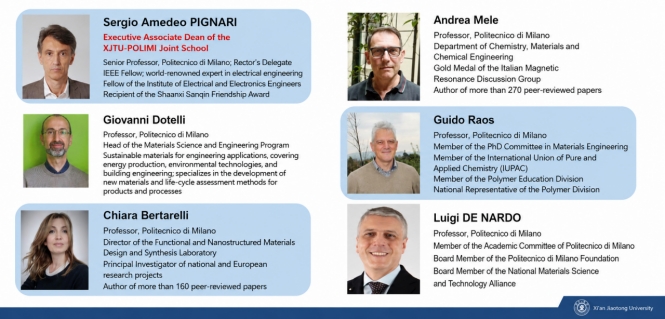
The program is supported by the strong faculty of the School of Materials Science and Engineering at Xi’an Jiaotong University. Among its full-time faculty members and researchers are four academy members, including members of the Chinese Academy of Sciences, the Chinese Academy of Engineering, the European Academy of Sciences, and the National Academy of Engineering of Korea; 17 national-level leading scholars; and 35 national-level young scholars. The School also has two Innovative Research Groups supported by the National Natural Science Foundation of China, three Innovation Teams of the Ministry of Education, and one of China’s first Huang Danian-style Faculty Teams. National-level high-level scholars account for 38.8% of the faculty, more than 80% of faculty members have overseas experience, and 82.5% are under the age of 45. The high-level teaching and research team jointly established by the two universities will provide comprehensive assurance for the quality of international talent cultivation.
New materials are a critical foundation and an important leading force for achieving the goals of carbon peaking and carbon neutrality and building China into a leading country in science and technology. In response to the major national demand for advanced materials in strategic emerging industries such as new energy, next-generation information technology, and high-end equipment manufacturing, the Materials Science and Engineering program will fully leverage Xi’an Jiaotong University’s traditional strengths in structural materials and the science of material strength, together with Politecnico di Milano’s leading expertise in functional materials, green materials design, and multiscale characterization. Through the combination of complementary strengths and interdisciplinary integration, the program will address fundamental scientific and engineering challenges underlying critical bottlenecks in key materials fields. It aims to cultivate internationally oriented outstanding engineering professionals who possess a strong sense of responsibility to their country and society, a global perspective, and an innovative spirit; systematically master the fundamental theories, specialized knowledge, and international frontier technologies of Materials Science and Engineering; and are capable of undertaking the research, development, design, production, and management of new materials, processes, and technologies.
The program is distinguished by the deep integration of the disciplinary strengths of the Chinese and Italian partners, the combination of theory and design, equal emphasis on preparation and characterization, the connection of properties with applications, and interdisciplinary convergence among materials science, information science, energy, biology, and other fields. Students receive systematic training in the fundamentals of materials science, materials thermodynamics and kinetics, materials physics and chemistry, materials preparation and processing, materials characterization methods, computational materials science, and sustainable materials design. This training enables them to solve complex engineering problems throughout the complete chain of new-material development and application, from composition design, process optimization, and microstructural control to the evaluation of in-service behavior.
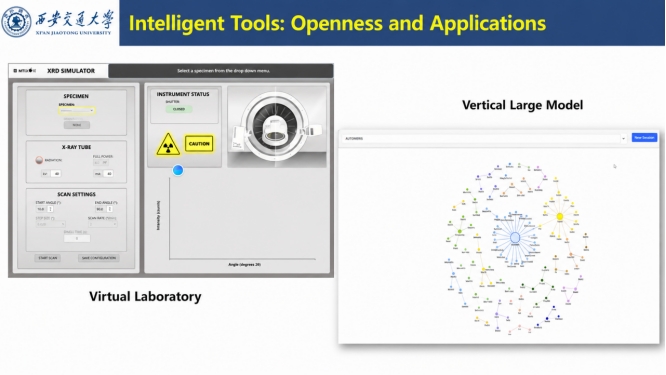
The program follows advanced educational principles centered on “materials design based on service environments,” “an emphasis on case-based teaching,” and “solving complex engineering problems.” Through joint teaching by Chinese and international faculty members, the introduction of real industrial projects into the classroom, and other integrated forms of training, the program emphasizes the development and application of intelligent methods. Digital teaching tools such as domain-specific foundation models for materials science and virtual laboratories are introduced to cultivate students’ ability to use artificial intelligence to improve the efficiency of materials research and development.
Guided by the Belt and Road Initiative, the program seeks to promote deep interdisciplinary integration between materials science and computational science, artificial intelligence, environmental science, and related fields. Through an open and collaborative international platform, it will enable the partner institutions to complement each other’s strengths and provide new talent support for addressing materials science challenges of global significance and serving national strategic development.
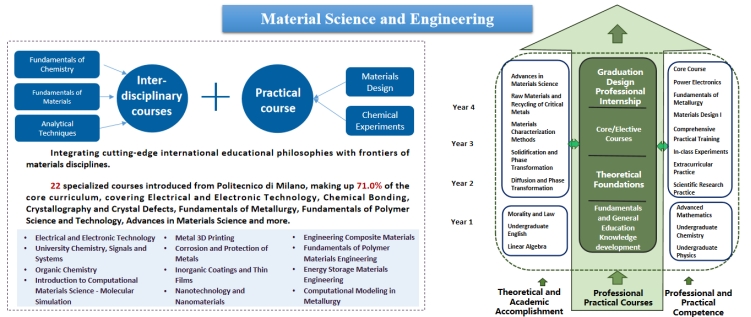
The curriculum is designed around the goal of cultivating interdisciplinary, internationally oriented, outstanding materials engineering professionals. It combines Xi’an Jiaotong University’s longstanding strengths in metallic materials and the science of material strength with Politecnico di Milano’s internationally leading advantages in functional materials, green materials design, and multiscale characterization, thereby establishing a forward-looking and interdisciplinary curriculum that reflects developments at the frontiers of the field. The curriculum covers the entire materials chain of “composition-microstructure-processing-properties-service” and integrates multidisciplinary knowledge from physics, chemistry, computational science, artificial intelligence, and other fields, enabling students to solve complex materials engineering problems systematically.
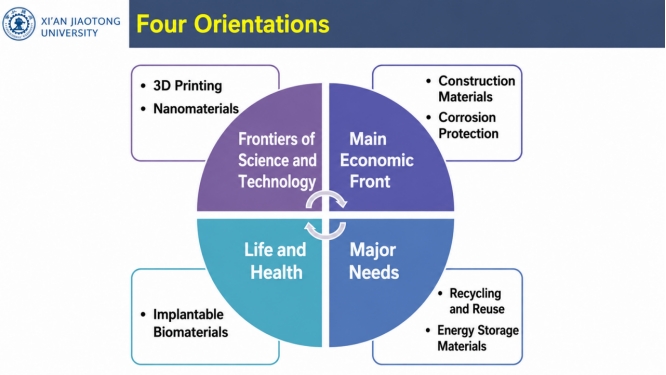
Drawing on the strengths of the faculty teams from both universities, the program establishes a high-level professional teaching team. High-standard experimental content and carefully planned laboratory facilities demonstrate the quality and depth of practice-based education. The program emphasizes materials design based on service environments, introduces intelligent teaching methods such as domain-specific foundation models and virtual laboratories, and strengthens case-based and project-driven teaching, thereby cultivating students’ ability to apply frontier technologies to improve the efficiency of new-material research and development.
By introducing industrial resources and research needs, the program enhances both curriculum-based and practice-based education and strengthens the integration of industry and education. Relying on national-level platforms such as the National Key Laboratory for Strength of Metallic Materials and on in-depth cooperation with leading enterprises including Aero Engine Corporation of China (AECC), China Baowu Steel Group, Contemporary Amperex Technology Co., Limited (CATL), LONGi Green Energy, and BYD, the program brings real industrial projects into the classroom. This approach closely aligns talent cultivation with industrial needs and prepares internationally competitive outstanding engineering professionals for China’s new-materials strategy and the goals of carbon peaking and carbon neutrality.
The program’s educational and practice platforms include three national key laboratories:
1. National Key Laboratory for Strength of Metallic Materials
Established in 1963, it is one of China’s earliest national key laboratories in the materials field. The Laboratory conducts applied fundamental research on the strengthening and toughening of materials, focusing on four major tasks: deformation, phase transformation, and strengthening and toughening of metallic materials; the design, preparation, and in-service behavior of high-performance coatings; multiscale structural control of materials integrating functional and structural properties; and the evolution and in-situ characterization of material micro- and nanostructures under multiple fields. It has formed an internationally influential innovation team led by Academician Sun Jun.
2. National Key Laboratory for Metallic Porous Materials
The Laboratory is jointly established by the Northwest Institute for Nonferrous Metal Research, Xi’an Jiaotong University, and Northwestern Polytechnical University. Its restructuring was completed and approved in December 2024. Positioned as an applied fundamental research laboratory, it focuses on major national needs related to the goals of carbon peaking and carbon neutrality, critical major equipment, and life and health, with the theory and technology for creating high-performance metallic porous materials as its core research direction.
3. National Key Laboratory for Metal Forming Technology and Heavy Equipment
The Laboratory is hosted by China National Heavy Machinery Research Institute Co., Ltd., with Xi’an Jiaotong University serving as a co-establishing institution. It focuses on frontier scientific questions and key technologies in metal forming. A number of open research projects proposed by Xi’an Jiaotong University have already been approved.
The program also has access to two national-level international cooperation and talent-introduction platforms:
Innovation and Talent Recruitment Base for Materials Deformation and Phase Transformation (the “111 Project”)
Led by Professor Sun Jun, this platform is part of the Higher Education Discipline Innovation Project jointly approved by the Ministry of Education and the former State Administration of Foreign Experts Affairs. It is dedicated to attracting internationally leading scholars and conducting frontier collaborative research on materials deformation and phase transformation.
International Joint Laboratory for Micro/Nano Manufacturing and Testing Technology
The Laboratory was jointly established by Xi’an Jiaotong University, the University of Birmingham, and the University of New South Wales. Supported by two national key laboratories, three key laboratories of the Ministry of Education, and three “111 Project” talent-introduction bases, it carries out extensive inter-university cooperation. With internationalization as a guiding principle, it has jointly educated more than 140 students with overseas partner institutions, trained more than 40 international postgraduate students, and actively recruited high-level professionals from abroad.
In addition, through the Western China Science and Technology Innovation Harbour, Xi’an Jiaotong University has established multiple university-enterprise joint research centers and practice bases integrating industry and education with leading enterprises including AECC, China Baowu Steel Group, CATL, LONGi Green Energy, and BYD, whose Xi’an production base has an annual output exceeding one million vehicles. Through integrated training involving interdisciplinary coursework, Sino-foreign cooperative research, and the introduction of real enterprise projects into the classroom, the program provides students with a high-quality, full-chain educational platform integrating foundational experiments, professional training, research practice, and industrial internships.
Q: What does Materials Science and Engineering study?
Materials Science and Engineering investigates the relationships among the composition, microstructure, preparation and processing methods, properties, and in-service behavior of materials. It draws on physics, chemistry, mathematics, mechanics, computational science, and many other disciplines. It addresses both fundamental scientific questions concerning the nature of materials and engineering and technological challenges involved in developing new materials and processes, thereby serving as a bridge between fundamental science and engineering applications. Materials Science and Engineering also provides the material foundation for pillar industries of the national economy, including artificial intelligence, aerospace, new energy vehicles, and high-end equipment. It is therefore both a foundational discipline of engineering and technology and a frontier field of research.
Q: What qualities and abilities are helpful for Materials Science and Engineering students? Is this program right for me?
We welcome students who are curious about the material world, possess strong foundations in mathematics, physics, and chemistry, enjoy hands-on experimentation, are skilled in logical analysis, and hope to create new materials and solve real-world problems. Students who are interested in the material principles underlying aerospace, new energy vehicles, chip manufacturing, biomedicine, green energy, and related fields will find this program particularly suitable.
Q: What are the core courses in Materials Science and Engineering?
Core courses delivered by the Chinese partner include Phase Diagrams and Solidification, Diffusion and Deformation, and Materials Characterization Methods. Distinctive courses taught primarily by the Italian partner include Fundamentals of Polymer Materials Engineering, Implantable Biomaterials, Materials Selection: Standards and Methodologies, Introduction to Computational Materials Science: Molecular Simulation, Materials Engineering for Energy Storage, and Advances in Materials Science.
Q: What are the distinctive educational features of the Materials Science and Engineering program?
The program is characterized by “the integration of science and engineering, Sino-Italian collaboration, interdisciplinary innovation, and intelligence-enabled development.” It upholds Xi’an Jiaotong University’s educational tradition of “high starting standards, solid foundations, rigorous requirements, and strong practical training,” while introducing Politecnico di Milano’s innovative approaches to functional materials and green design. The program emphasizes materials design based on service environments and case-based teaching, cultivates the ability to solve complex engineering problems, and actively introduces intelligent tools such as domain-specific foundation models and virtual laboratories to develop students’ capacity for future-oriented new-material research and development.
Q: Where do graduates of Materials Science and Engineering work?
Career opportunities are exceptionally broad and span sectors that are strategically important to the nation and have an urgent need for specialized, cutting-edge professionals. Graduates may work in the following fields:
Strategic emerging industries: semiconductors and integrated circuits, such as Semiconductor Manufacturing International Corporation and Huawei HiSilicon; new energy, such as CATL, BYD, and LONGi Green Energy; and aerospace, such as Commercial Aircraft Corporation of China and Xi’an Aircraft Industry.
Upgrading of traditional manufacturing: research and development centers of major state-owned enterprises in automobile manufacturing, iron and steel metallurgy, petrochemicals, and related industries.
Research and educational institutions: leading universities and research institutes in China and abroad.
Government agencies: customs, quality inspection, market regulation, and related authorities.
A strong technical foundation and comprehensive abilities also enable graduates to develop careers in professional service fields such as finance, consulting, and intellectual property.
Q: How does the Materials Science and Engineering program at the XJTU-POLIMI Joint School differ from the program in Xi’an Jiaotong University’s School of Materials Science and Engineering and from programs at other leading Chinese universities formerly included in Project 985? What are its advantages?
The principal differences lie in its combination of “New Engineering, internationalization, strong interdisciplinarity, and intelligence-enabled education.” The program is supported by Xi’an Jiaotong University’s A-rated discipline, ranked 24th globally by U.S. News and 16th globally by ShanghaiRanking, and by Politecnico di Milano’s strong European discipline, creating a substantive partnership between complementary areas of excellence. Its main advantages are:
Degrees from both universities: graduates may receive degrees from both the Chinese and Italian partner institutions.
International curriculum: more than one-third of the core courses are delivered by professors from Politecnico di Milano.
Intelligence-enabled education: the curriculum incorporates advanced teaching methods such as domain-specific foundation models and virtual laboratories.
Global perspective: the program focuses on materials challenges associated with global issues in energy, the environment, health, and related fields.
Q: What kinds of growth and training can I gain from studying this program?
Students will develop a systematic and in-depth body of knowledge in materials science, master advanced skills in materials research, development, and characterization, and cultivate the ability to solve both “zero-to-one” challenges in original materials innovation and “one-to-one-hundred” challenges in engineering scale-up and application. At the same time, their global perspective, cross-cultural communication abilities, critical thinking, and sense of responsibility to their country and society will be comprehensively strengthened.
Q: What is the most difficult part of studying this program, and what is the most attractive part?
The principal challenges are the breadth of the subject matter, the abstract nature of the theories, the high standards required in experimentation, which demand patience and rigor, and the language requirements associated with core courses taught in English. The most attractive aspect is the sense of achievement that comes from creating new forms of matter with one’s own hands. A high-temperature-resistant alloy developed by a student may one day be used in an aerospace engine; a nanoscale catalyst designed by a student may efficiently convert carbon dioxide into fuel; and a biomaterial prepared by a student may help save lives. This experience of “creating the future” is unique.
Q: Does the Materials Science and Engineering program offer international cooperation projects or exchange opportunities?
Yes, it offers many such opportunities. The program itself is a major platform for international exchange. Students benefit from the faculty and network resources of both universities and may have opportunities to participate in summer schools at Politecnico di Milano and receive joint supervision for their graduation design or thesis. International exchange is a core feature and a major advantage of the program.
Q: What are the development prospects of Materials Science and Engineering, and in which fields can I apply what I learn?
The prospects are exceptionally broad. Materials Science and Engineering is explicitly identified as a key and core technology field in China’s 14th Five-Year Plan and the Long-Range Objectives Through the Year 2035. Students may apply their expertise in new-material development, semiconductors, new energy, biomedicine, aerospace, national defense, and other core sectors, becoming outstanding innovative professionals urgently needed by the country.
Q: Who are some distinguished professors in Materials Science and Engineering at Xi’an Jiaotong University, and what roles will they play in my university experience?
The program has many distinguished professors, including Academician Sun Jun, Academician Li Helin, Academician Ma En, and Academician Suck Joo Na. They serve as academic mentors who illuminate students’ paths of scientific exploration, as practical advisors who guide students into national key laboratories to solve real problems, and as companions in students’ growth who provide detailed guidance in academic planning, research initiation, and career development. Many professors personally teach undergraduate courses and serve as academic advisors.
Q: How should we understand the opportunities in traditional materials industries, such as iron and steel and nonferrous metals, and in emerging materials fields, such as semiconductors, new energy, and biomaterials? How can students adapt to the development of the times?
Traditional materials industries are undergoing transformation and upgrading through digitalization and intelligent technologies and therefore have a substantial demand for high-level research and development professionals. Emerging fields are creating entirely new technological and market opportunities. The two are not substitutes for one another; rather, they develop in coordination. Students should establish a solid foundation in core knowledge, actively embrace interdisciplinary learning, for example by studying Python, computational simulation, and the use of foundation-model tools, closely follow national strategies and industrial frontiers, and integrate their personal development into the broader endeavor of building China into a leading country in science and technology and advancing national rejuvenation.
Friendship Link :
西安交通大学