
版权所有©2022西安交大米兰理工联合学院
Contact:iHarbour,Xi'an,Shaanxi,710049,P.R.China Tel:0089-29-88960094
1. Current State of the Industrial Design Industry
Industrial design is a process of creation, invention, and definition. It is an innovative activity that reorganizes the elements of production to recreate value; it constitutes a core source of value in the industrial economy, a vehicle for cultural communication, and a medium and driver of innovation. Its purpose is to drive innovation, build business success, and improve quality of life by applying a strategic problem-solving process to products, systems, services, and experiences. Against the backdrop of a new round of technological revolution and industrial transformation, industrial design is playing an increasingly prominent upstream role in guiding industrial chains and value chains. Its pioneering capacity to transform knowledge, technology, information, and creativity into products, processes, equipment, and services is becoming increasingly important to economic and social development. Industrial design shapes the quality of products and services; it is a critical link in translating scientific and technological achievements into practical applications, creating new market demand, and promoting high-quality industrial development.
More than 20 countries have incorporated industrial design into their national development strategies and regard it as an important means of strengthening national soft power. Countries including the United States, the United Kingdom, Germany, Japan, and the Republic of Korea have established industrial design advisers to national leaders, national industrial design councils, or dedicated government departments for industrial design. The Netherlands, Finland, Japan, the Republic of Korea, Australia, and other countries have also introduced design promotion policies and incorporated them into national development strategies.
2. Industry Prospects and Development Trends
With rapid technological advancement, particularly the advent of the Fourth Industrial Revolution, the concept of industrial design is continually evolving and expanding. Design today no longer serves only the creation of objects for manufacturing and everyday life. Guided by the concept of Broad Design, it is breaking through established knowledge structures and professional boundaries and becoming deeply integrated with advanced manufacturing, engineering and construction, the digital economy, and cultural and creative industries. As a result, design increasingly demonstrates high levels of innovation intensity, knowledge intensity, and added value. As a core link that empowers industrial manufacturing, industrial design has distinctive advantages within the innovation chain and is one of the areas with the greatest potential for value creation in the manufacturing value chain.
Although industrial design developed relatively late in China, a series of supportive policies has brought the sector into a period of rapid growth. Shenzhen, where industrial design has developed particularly quickly, provides a representative example: in 2022, the city's industrial design sector generated a total output value of RMB 45 billion and drove more than RMB 1 trillion in output across upstream and downstream industries, demonstrating its substantial contribution to quality improvement and efficiency gains in manufacturing. In the past, many companies understood industrial design primarily as the styling of product appearance and had only a limited appreciation of its commercial value, resulting in very low investment in design-led innovation. As market competition continues to intensify, however, companies will have stronger demand for industrial design in core activities such as product positioning, translation into production, and brand building. Industrial design will consequently evolve toward a more integrated and comprehensive form of design.
(1) Industrial Design Empowering the Shift from “Made in China” to “Created in China”
In the new era, industrial design has expanded from a tool mainly used to improve product appearance into a widely applicable form of innovative knowledge that can engage participants across society. It breaks down disciplinary boundaries and promotes close collaboration among scientists, engineers, artists, and designers. These new modes of collaboration generate powerful momentum across different fields, bringing new vitality to China's industrial economy, cultural development, and public well-being; design has also become an important calling card for China on the global stage. China is working to promote the transformation from “Made in China” to “Created in China,” from “China's speed” to “China's quality,” and from Chinese products to Chinese brands. As one of the links with the greatest potential for value creation in the manufacturing value chain, industrial design will play an increasingly important role and generate greater value as China pursues high-quality development and fosters the dual-circulation development pattern. China has become a major global manufacturing power, and industrial design capability is an important indicator of the level of industrialization of a country or region. Over the past decade, China's industrial design capacity has achieved leapfrog development and has played a key role in raising the overall standard of Chinese manufacturing and advancing industrial upgrading and transformation.
1) Industrial Design for High-End Equipment
Over the four decades since the launch of reform and opening up, China has progressed from imitation and catch-up to innovation-driven advancement. Against the background of economic transformation and upgrading, as well as growing public demand for a better life, industrial design has moved from relative obscurity to receiving increasing attention from enterprises. In the design and development of high-end equipment, industrial design can reorganize production factors and improve product quality. It is particularly important in the ergonomics and human-factors design of major equipment for deep-sea and deep-space exploration, large aircraft, and related fields, where industrial design and manufacturing upgrading reinforce one another.
According to the Design Economy Data of Guangdong Industrial Design City, the overall contribution of Guangdong's industrial design sector to social and economic development increased tenfold over a ten-year period. Among industrial enterprises above designated size in Guangdong, the value-added effect generated by industrial design investment reached 137.02 in 2021. In other words, each RMB 10,000 invested in industrial design generated approximately RMB 1.3702 million in value returns. Industrial design has therefore become an important source of innovative momentum for industrial upgrading.
2) Design of Automobiles, High-Speed Trains, and Other Means of Transport
As one of China's strategic emerging service sectors, industrial design is receiving increasing attention from all sectors of society. This is especially evident during the current critical period of industrial restructuring and upgrading. In the automotive industry, particularly in the field of new-energy vehicles, industrial design is becoming an increasingly important source of corporate competitiveness. For electric multiple-unit trains, high-speed trains, and other means of transport, lightweight design, exterior styling that integrates aesthetic and engineering requirements, automotive interior design, smart-cockpit interaction design, and user experience design are essential to breaking the dominance of overseas design companies. These capabilities also lay the foundation for transport products with distinctive Chinese design characteristics and independently owned intellectual property rights.
3) Design of Wearable Products, Home Appliances, and Consumer Electronics
Industrial design should not be narrowly understood as product design alone. Design capability uses design as a means of integrating resources across the industrial chain and guiding both product innovation and industrial innovation. As Chinese manufacturing transforms and upgrades, collaboration between industrial design and manufacturing enterprises is becoming increasingly close. Models in which industrial design provides targeted services to manufacturers have become common, and an industrial design ecosystem has begun to take shape.
In the design of smartphones, tablets and laptops, wearable devices, and related products, industrial design can reshape consumer habits and create entirely new product markets. In recent years, Huawei smartphones, Lenovo computers, smart home appliances from Midea, Gree, and Haier, and smartphones and set-top boxes from brands such as Xiaomi and Honor have all provided strong examples of innovation enabled by industrial design at the industry level.
4) Industrial Design of Medical Devices and Service Systems
Industry-oriented design most clearly demonstrates the high-end service value of industrial design. In healthcare, industrial design can fully exercise its pioneering and guiding role. Starting from an understanding of advances in medicine and social progress, designers can integrate technological trends, cultural change, and broader developments in human society to create original concepts for medical devices and service systems. They can also coordinate and guide different functions within enterprises, integrate advanced digital and industrial technologies and manufacturing resources from around the world, and develop new medical devices, service systems, and related products.
(2) Human-Computer Interaction and the Metaverse
The metaverse seeks to enable the digitalization and intelligent transformation of all things, create a mixed physical-digital environment in which people are fully surrounded by information, and ultimately generate new social forms that transcend conventional spatial and temporal boundaries. Human-computer interaction is one of its key enabling technologies. Bridging the gap between technology and users requires industrial design to address user perception, operation, and experience throughout this process.
As China gradually implements its innovation-driven development strategy, local governments are accelerating efforts to promote industrial design. Guangdong, Shandong, Zhejiang, Jiangsu, Gansu, Hebei, Jiangxi, Shenzhen, Chongqing, Xiamen, and many other provinces and cities have introduced policies and measures to support the sector, producing clear benefits for local development. The deep integration of manufacturing and modern services has become an important means of strengthening the core competitiveness of manufacturing, cultivating a modern industrial system, and achieving high-quality development.
1) User Research and Interaction Interface Design
One of the core strengths of industrial design is its ability to identify user needs. Against the background of profound changes unseen in a century, the environment in which industrial design develops has changed substantially. As consumption in China upgrades, deeper and increasingly diverse consumer needs have been activated. Industrial design is human-centered: it gives full consideration to people's lives and needs, as well as to the sustainable development of society as a whole. It is centered on value creation and seeks to create value that can be sustained over time.
Over the four decades since reform and opening up, China has moved from being a major manufacturing country toward becoming a major force in creation and innovation, while industrial design has served as a central engine differentiating the manufacturing capabilities of different countries. Excellent industrial design can substantially reduce costs and improve efficiency while also increasing product added value. It can become a symbol of a brand and drive the emergence of new economic models across industries.
2) User Experience Design
China's consumer market has risen rapidly, and Chinese consumers are increasingly willing and able to pay for good design. To provide the best possible user experience, greater attention must be given to optimizing the internal functions of products, and designers should develop high-quality products from the user's perspective. Consumption upgrading also requires companies to transform their business philosophy: enterprises seeking sustainable long-term development must value both innovation and design.
Industrial design links technological innovation upstream with industrial development downstream and has an important and irreplaceable role in implementing the innovation-driven development strategy. Accelerating its development is therefore highly significant for supporting and advancing China's supply-side structural reform and for comprehensively promoting technological, product, industrial, and business-model innovation. Industry is the principal component of the real economy. As 5G, artificial intelligence, and the Internet of Things generated through the Internet Plus initiative are implemented more deeply, Industry 4.0, integrated with digital industrial design, is penetrating an increasingly wide range of sectors.
Supported by a succession of national policies for industrial design and by the transformation of manufacturing associated with Made in China 2025, the size of China's industrial design market nearly doubled within only a few years, increasing from RMB 126 billion in 2017 to RMB 207.1 billion in 2021. Industrial design has rapidly come to be regarded as one of the most effective entry points for industrial transformation and upgrading. Because it can extend across the entire life cycle of technology products, it has become a strategic resource. Understanding and responding to industrial design trends is therefore comparable to holding a technological entry ticket to the emerging global landscape.
3) VR, AR, and XR Application Design
The integration of virtual reality technologies such as VR, AR, and XR with medical training, educational simulation, culture, and tourism can generate entirely new forms of products and services. By applying industrial design methods and ways of thinking, these technologies can upgrade tourism and consumption experiences through applications such as immersive experiences and smart visitor guidance.
It is important to emphasize that industrial design is not superficial decoration. According to estimates by the Industrial Designers Society of America, each US dollar invested in the appearance of an industrial product can generate a return of US$1,500. At Hitachi in Japan, industrial design reportedly accounts for 51 percent of every additional JPY 100 billion in sales revenue, whereas technical modifications to products account for only 12 percent. Industrial design is therefore a powerful means of expanding product categories, increasing added value, and enhancing brand competitiveness.
At a time when the real economy extends throughout China, and as the industrial internet platform system advances under Industry 4.0, the value of industrial design is being further elevated. Industrial design bears an important responsibility for promoting the digital, networked, and intelligent upgrading of traditional industries.
(3) Cultural and Creative Design and the Integration of Technology and Culture
Creative design also has considerable potential in fields such as the digitalization of traditional culture, digital performing arts, smart tourism, exhibitions and displays, cultural relic restoration, and livestreaming. The innovative, low-carbon, and high-quality development of the culture and tourism economy likewise requires design creativity. Integrated cultural and technological design, intellectual property character design, and interactive experience design can create new forms of business and consumption for scenic areas and other destinations.
Today, frontier technologies represented by artificial intelligence are reshaping the supply and demand structure of cultural products and affecting everyday life at an unprecedented and often unpredictable speed. In an era of culture and tourism shaped by both new technology and deep cultural heritage, industrial design can upgrade tourism experiences through immersive environments, smart guidance, and related applications. In this sense, it is an important way in which new quality productive forces contribute to the development of the culture and tourism economy.
1) Design and Development of Cultural and Creative Products
The principal pathways through which industrial design enables the green development of the culture and tourism economy include innovation driven by digital technology, artificial intelligence, and big data; the development of green tourism products such as virtual-reality tourism and digital museums; the application of intelligent management systems; and support from relevant policies. Designers can use interactive installations and interactive landscape products to enable the innovative inheritance of culture through digital technologies.
As a form of cultural and spiritual production, cultural tourism depends not only on technological innovation but also on accumulated cultural resources and a social environment that encourages innovation. By taking cultural inheritance and innovation as a central point of leverage, the sector can build enduring vitality. The integration of industrial design and culture can construct an advanced and intelligent future for the culture and tourism economy while also connecting the past with the present and enabling culture to be protected, inherited, and renewed.
2) Cultural Heritage Conservation and New Product Development
The integration of industrial design and digital technologies is also widely applied in cultural relic restoration and the design-based regeneration of cultural heritage. Three-dimensional scanning and 3D printing, for example, can support both the digital conservation of cultural relics and new forms of design creation. The development of services, interactive installations, and immersive products based on cultural heritage themes is likewise an important current direction.
(4) Materials Application Design and the Development of Low-Carbon, Ecologically Sustainable Products
In view of rapid population growth, shortages of natural resources, and serious environmental pollution, green, healthy, and sustainable ecological design has become a mainstream design trend. Guided by ecological thinking, this approach gives systematic consideration to the environmental attributes of products throughout their life cycles. It assesses not only product quality, functions, and finished outcomes, but also subsequent treatment and recycling, while integrating aesthetic value and innovation.
In addition to the product itself, designers must consider how to improve related services while increasing product efficiency. This places higher requirements on product design and contributes to the creation of a long-term and sustainable consumption environment.
(5) Other Fields of Design
At its core, industrial design seeks to create products that offer higher quality, greater efficiency, lower costs, and a closer fit with user needs. For this reason, it has become a powerful catalyst for integrating different sectors, empowering industries, and promoting economic development. Industrial design can guide the integrated innovation of production factors and the optimization of industrial structures, while using a wide range of innovative achievements to recreate value.
Production factors today extend beyond land, labor, and capital to include knowledge, information, data, and other new factors. Their organization and value enhancement are therefore increasingly important. At the same time, the rise of artificial intelligence, big data, cloud computing, and other emerging technologies is generating profound changes in industrial clusters and reshaping modes of production and economic structures. Industrial design will be a key force within this transformation.
The Industrial Design program at Xi'an Jiaotong University was founded in 1998 and enrolled its first undergraduate cohort in 1999. It was authorized to confer master's degrees in Art Studies in 2000, master's degrees in Engineering in 2001, and independently established doctoral degrees in Engineering Art and Design in 2002. In 2003, it became the first university program in the Chinese mainland to join the World Design Organization (WDO, formerly the International Council of Societies of Industrial Design, ICSID). In 2024, it was authorized to offer an independently established doctoral program in Design Studies.
The program has received a number of honors and awards, including the Second Prize of the National Teaching Achievement Award, the Special Prize of the Shaanxi Provincial Higher Education Teaching Achievement Award, and recognition as a Prestigious Major of Shaanxi Province. The World Design Organization has described XJTU's Industrial Design program as being “in line with the world's most modern industrial design education programs.” It was approved as a National First-Class Undergraduate Program Development Site in 2021. In 2022, Xi'an Jiaotong University and Politecnico di Milano jointly launched an international model for design education. In ShanghaiRanking's 2023 Best Chinese Majors Ranking, the program received an A+ rating and ranked among the top three nationwide; in the 2024 Times Higher Education China Subject Ratings, it also received an A+ rating and ranked among the top four nationally.
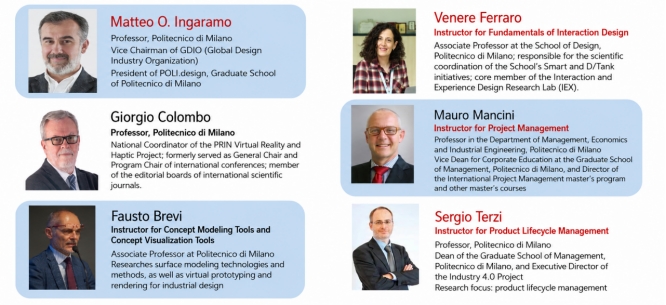
Politecnico di Milano ranked sixth worldwide in Art and Design in the 2025 QS World University Rankings by Subject and is home to one of Europe's leading design schools. Its curriculum emphasizes interdisciplinary integration and combines design with engineering, architecture, management, and other fields to cultivate broadly capable design professionals. At the XJTU-POLIMI Joint School, core professional courses introduced from the Italian partner account for 66.6 percent of the program. These 14 courses include Tools for Concept Visualization, Fundamentals of Product Design, and Innovative Programming.
Faculty members are jointly selected and appointed by the Chinese and Italian partner universities. The Joint School has established an Academic Committee composed of distinguished scholars from China and abroad. Drawing on Xi'an Jiaotong University's strengths in electrical engineering, mechanical engineering, mathematics, physics, and other disciplines, the School appoints outstanding scholars from both within and outside the University. Politecnico di Milano assigns experienced faculty members and teams of doctoral teaching assistants to deliver more than one-third of the core courses. More than 30 faculty members from the two universities jointly support the School's teaching and research activities.
The Industrial Design program implements a holistic “Three-All Education” approach—education by all staff, throughout the entire process, and in all dimensions. It combines character development, knowledge transmission, competence cultivation, and innovative thinking within an integrated four-part model, while promoting the coordinated development of moral, intellectual, physical, aesthetic, and labor education. Guided by the core values of diligence, sincerity, resolve, and consideration for others, the program engages with the international frontier of industrial design and follows the educational philosophy of “New Engineering, Broad Design, and Emphasis on Interdisciplinarity.” It highlights the interdisciplinary integration of intelligence, digitalization, and artistry, and focuses on systematic design services for wearable products, robots, high-end equipment, bio-inspired manufacturing, 3D printing, and intelligent products. While developing students' industrial design capabilities, the program places particular emphasis on strengthening innovative practice through interdisciplinary integration.
Through systematic coursework and professional practice, students acquire the fundamental theories, knowledge, and design methods of Design Studies and related disciplines. They develop the capacity for invention and creation, product definition, excellent design communication, proficient computer-aided design, and the interdisciplinary integration of knowledge. In product design, service design, design management, and design research, graduates are expected to solve complex design problems effectively. With innovative thinking and strong cultural and artistic accomplishment, they will become key professionals and future leaders in design and development, culture and creativity, planning and management, teaching and research, and related fields.
The curriculum fully considers current disciplinary trends and society's emerging demand for professionals trained in Broad Design. It deeply integrates Chinese and international courses and has established a preliminary “one-spine, multiple-axis” curriculum centered on design practice. Design practice serves as the principal spine connecting different forms of knowledge, while engineering, technology, art, society, aesthetics, and other disciplinary domains are integrated into students' knowledge structures as multiple complementary axes.
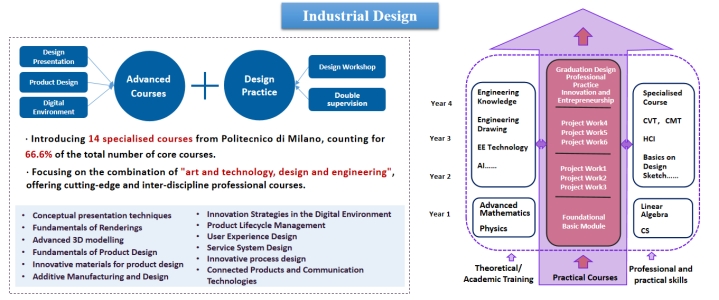
Practice platforms include the Astronaut Center of China; Beijing Chehejia Information Technology Co., Ltd. (Li Auto); Tencent Technology (Shenzhen) Co., Ltd.; Peking Union Medical College Hospital, Chinese Academy of Medical Sciences; and Tongji Medical College, Huazhong University of Science and Technology. Through interdisciplinary coursework, Sino-foreign cooperation in industry-education integration, and the introduction of real corporate design projects into studio teaching, students receive comprehensive training beginning with preparation for employment. The program establishes a progressive, multi-level development pathway from design assistant and junior designer to product manager, design supervisor, and design leader. In accordance with students' cognitive development and growing capabilities, the difficulty and complexity of practical work are increased step by step.
The Department has also signed cooperation agreements with a number of companies that provide internships and has established enterprise-based practice centers. The university-enterprise collaborative education ecosystem includes joint education bases, faculty teams, teaching environments and project resources, collaborative training models, and mechanisms for assuring the quality of talent development.
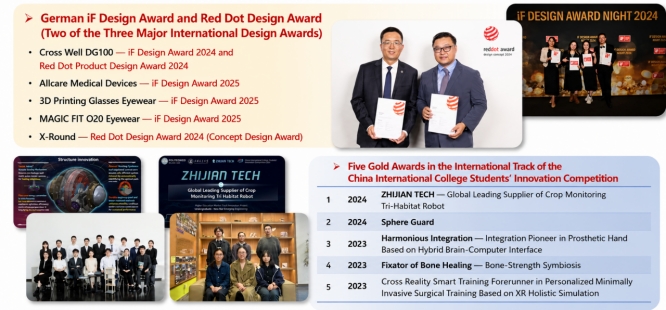
To date, students across three cohorts have collectively received 39 national awards, 78 provincial or ministerial awards, and more than 40 university-level awards. Five faculty-student teams have won six awards from the world's three major design award systems, including four German iF Design Awards and two Red Dot Design Awards. Five project teams have won gold awards in the international track of the China International College Students' “Internet+” Innovation and Entrepreneurship Competition, with faculty members from both partner universities serving jointly as supervisors for every project. One project was shortlisted among the top eight for the James Dyson Award. One student team received a Finalist Award in the 2023 Mathematical Contest in Modeling, and one student won a gold medal at the Hangzhou Regional of the International Collegiate Programming Contest (ICPC). Two students received, respectively, the Special Prize—of which only one was awarded across the province—and the First Prize—of which only three were awarded across the province—in the 2024 Shaanxi Provincial Foreign-Language Speech Contest for Students in Sino-Foreign Cooperative Education Programs. One student was recognized as a University-Level Outstanding Student Pacesetter, and 19 students received national scholarships.
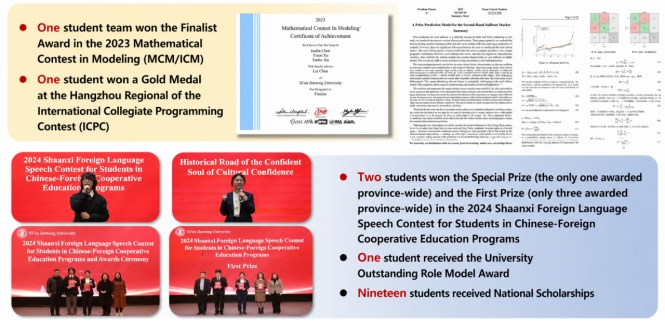
Over the past three years, approximately 30 percent of graduates from Xi'an Jiaotong University's Industrial Design program have received offers each year from leading universities and institutions in China and abroad. These include the University of Cambridge, the Royal College of Art, Imperial College London, Delft University of Technology, the Georgia Institute of Technology, and Technische Universität Berlin. Graduates are employed by major companies in China and internationally, including Deutsche Telekom, Huawei, Tencent, Baidu, Alibaba, and Microsoft Research Asia, where they work as product managers, product design directors, and in related positions. Their remuneration is generally above the industry average.
Q: What does industrial design study? Is it simply about product appearance and styling?
With rapid technological advancement, particularly the advent of the Fourth Industrial Revolution, the concept of industrial design is continually evolving and expanding. Design today no longer serves only the creation of objects for manufacturing and everyday life. Guided by the concept of Broad Design, it is breaking through established knowledge structures and professional boundaries and becoming deeply integrated with advanced manufacturing, engineering and construction, the digital economy, and cultural and creative industries. Industrial design is a creative activity whose professional scope now extends far beyond traditional product styling. Its ultimate purpose is to serve human well-being and create a better life through human-centered design.
Q: What qualities and abilities are suited to industrial design? How can I tell whether the program is right for me?
Students with empathy and curiosity, who are sensitive to new developments and remain enthusiastic about continuous exploration, are well suited to industrial design. Being open-minded, motivated to improve real-world conditions, and capable of analysis and synthesis are additional strengths. Industrial design is also a highly practice-oriented field, and students who enjoy making, experimenting, and hands-on work are especially welcome.
Q: Does a background in drawing provide an advantage? Will students without drawing experience be at a disadvantage?
Everyone has creative potential; what matters is developing creative confidence. Hand drawing is only one form of visual thinking, and drawing provides a useful window through which ideas can be expressed. Today, computer graphics and AI-generated content technologies increasingly empower industrial design, so a lack of prior drawing experience does not prevent students from inventing, creating, or defining products. The program follows a Broad Design model that integrates science, technology, management, art, and other disciplines. Through this interdisciplinary education, students with different backgrounds can all develop the capabilities needed to succeed.
Q: I am determined to study at Xi'an Jiaotong University. Could you explain the difference between Industrial Design and Mechanical Engineering?
Drawing on the foundation of the School of Mechanical Engineering, Xi'an Jiaotong University's Industrial Design program has, over more than two decades, developed an educational approach characterized by a strong engineering foundation, character development, humanistic cultivation, practical training, and an international outlook. Put simply, mechanical engineering mainly addresses relationships among machines, components, and technical systems, whereas industrial design places greater emphasis on coordinating and integrating the relationship between people and products.
Q: How does the Industrial Design program at the XJTU-POLIMI Joint School differ from the program formerly housed in XJTU's School of Mechanical Engineering and from programs at other Project 985 universities? What are its advantages?
The Industrial Design program at the XJTU-POLIMI Joint School takes Broad Design as its central disciplinary concept and is distinguished by internationalization and an emphasis on practice. Building on Xi'an Jiaotong University's strengths in engineering, it focuses on students' design innovation and genuine professional competence, promotes the deep integration of technology and art, combines Sino-foreign cooperation with industry-education integration, and advances university-enterprise collaborative education. The program was founded in 1998 on the strong foundation of XJTU's first-level discipline of Mechanical Engineering and enrolled its first undergraduate students in 1999. It was authorized to confer master's degrees in Art Studies in 2000, master's degrees in Engineering in 2001, and independently established doctoral degrees in Engineering Art and Design in 2002. In 2003, it became the first university program in the Chinese mainland to join the World Design Organization, formerly ICSID. The program has received honors including the Second Prize of the National Teaching Achievement Award, the Special Prize of the Shaanxi Provincial Higher Education Teaching Achievement Award, and recognition as a Prestigious Major of Shaanxi Province. It has also been described by an international industrial design organization as being “in line with the world's most modern industrial design education programs.” The program was approved as a National First-Class Undergraduate Program Development Site in 2021, received an A+ rating and ranked among the top three nationwide in ShanghaiRanking's 2023 Best Chinese Majors Ranking, and received an A+ rating and ranked among the top four nationally in the 2024 Times Higher Education China Subject Ratings.
Q: Industrial design is sometimes regarded as little more than producing drawings, with demanding workloads and limited pay. How would you respond to this view?
Visual presentation is often mistaken for the principal work of design professionals, but this is a misunderstanding of industrial design. At its core, industrial design is about creation and the definition of the future. It uses care, empathy, and social responsibility to envision future ways of living and production, helps industries plan more rational modes of life, and constructs sound relationships among people, products, production, and society. Only by fully realizing the professional value of industrial design can designers create greater social wealth.
Q: What are the core courses in the Industrial Design program?
Innovative industrial designers educated under the Broad Design concept should possess a foundation in engineering and technology. Core courses in this area include Fundamentals of Mechanical Design and Manufacturing, Innovative Programming, Internet Products and Communication Technologies, Innovative Materials for Product Design, Electrical and Electronic Technology, and Human-Computer Interaction Technology and Design Applications.
Industrial designers must also possess essential design skills and the ability to communicate design ideas. Core courses supporting these capabilities include Conceptual Representation Techniques, Advanced 3D Modeling, Fundamentals of Design Rendering, User Experience, and Design Semiotics.
More importantly, industrial designers need the capacity for creative invention, product definition, analysis, and synthesis. Courses related to design thinking and product development therefore form another central component of the curriculum, including Design Thinking and Practice, Fundamentals of Product Design, Innovation Strategies in Digital Environments, and Interdisciplinary Product Development.
The Industrial Design program at the XJTU-POLIMI Joint School currently offers 27 core courses, of which 14 are provided by Politecnico di Milano and 13 by Xi'an Jiaotong University. Detailed course information is available on the official website of the Joint School.
Q: What are the distinctive features of the program's educational model?
Throughout more than two decades of development, the program has upheld the educational philosophy of providing a solid foundation, maintaining rigorous standards, emphasizing practice, and pursuing innovation. Based in western China and responding to the demand for industrial design professionals generated by economic and social development, it actively follows international trends in industrial design education. Building on the cultivation of humanities, character, and competence, the program continuously improves its talent-development system and closely integrates theoretical teaching with practical training. While developing students' industrial design and innovative practice capabilities, it also strengthens their humanistic qualities, international outlook, leadership, proactive learning, and teamwork. Graduates are highly valued by employers for their strong character, solid foundations, professional competence, and long-term potential.
Following an evaluation, the World Design Organization stated that the program was aligned with the direction of the world's most modern industrial design education programs. In the new era, the program will continue to cultivate character and innovative capability and to develop genuine professional competence through design practice. Grounded in the Broad Design concept and at the international frontier of industrial design, it aims to educate design leaders who possess systematic knowledge of the fundamental theories of industrial design and strong specialist knowledge in product, service, and experience design; who can solve complex design problems effectively in product development, service design, design management, design research, and related positions; and who demonstrate innovative awareness, innovative thinking, and the capacity for continuous self-renewal and growth.
Q: What kinds of growth and training can I expect from studying this program?
Students develop a solid foundation in engineering and technology, greater empathy, stronger capacities for analysis and synthesis, and enhanced creativity.
Q: What is the most difficult aspect of studying industrial design, and what is the most attractive aspect?
The greatest difficulty lies in the interdisciplinary and integrative nature of the field. Students need rational thinking to master engineering knowledge related to structures, technologies, and materials, while also developing the artistic sensitivity required to address aesthetics and cultural meaning. At the same time, they must balance ecological and ethical considerations, regulations, actual production constraints, and cost limitations. The most attractive aspect is the materialization of creativity: abstract concepts can be transformed into tangible and experienceable products, services, and systems that directly affect people's quality of life and emotions. When a design initially drawn by hand ultimately becomes a real product, the resulting sense of achievement—combining artistic value with social significance—is irreplaceable.
Q: Where do graduates of the Industrial Design program pursue further study and employment?
Graduates possess broad knowledge and strong capabilities in innovation and entrepreneurship and are highly recognized by employers in China and abroad. Over the past three years, approximately 70 percent of graduates have received offers each year from leading universities and institutions in China and internationally. These include the University of Cambridge, the Royal College of Art, Imperial College London, Delft University of Technology, the University of Pennsylvania, the Rhode Island School of Design, the Georgia Institute of Technology, Technische Universität Berlin, Peking University, Shanghai Jiao Tong University, and Zhejiang University. Graduates work at major companies such as Huawei, ByteDance, Baidu, Alibaba, Tencent, Meituan, Xiaomi, Volkswagen, Li Auto, and China Mobile. They serve as product managers, user interface designers, user experience designers, user researchers, product designers, and in related roles, and many become key technical contributors and members of their organizations' core management teams.
Q: Does the program offer international cooperation projects or opportunities for international exchange?
Through intergovernmental cooperation frameworks and reciprocal visits by experts, faculty members from Xi'an Jiaotong University and Politecnico di Milano have jointly carried out a number of international cooperation projects.
Xi'an Jiaotong University and Politecnico di Milano have also signed a student exchange agreement. Each year, approximately 50 interested second-year students are selected to undertake summer study at Politecnico di Milano. Students may also participate in credit-transfer exchange programs and summer programs offered through XJTU's partnerships with more than 300 universities worldwide. To date, 39 students have participated in summer programs at institutions including the University of Oxford, the University of Cambridge, Imperial College London, the Royal College of Art, and the National University of Singapore.
Q: What are the future prospects for industrial design, and in which fields can I apply what I learn?
Industrial design plays an important role in increasing product added value, strengthening the core competitiveness of enterprises, and promoting the upgrading of industrial structures. The industry is expected to maintain strong development momentum, creating sustained demand and broad career prospects for professionals with innovative ability, design capability, and technical expertise.
Q: Who are some of the program's distinguished professors, and what roles will they play in my university education?
The Industrial Design program at Xi'an Jiaotong University has a number of distinguished and highly committed professors with interdisciplinary backgrounds. Their work spans new product design and development, human-computer interaction, virtual reality, digital design, and related fields. They play multiple roles in students' university lives: as academic mentors, they provide rigorous teaching and research guidance that helps students build a solid professional foundation and understand frontier developments; as guides to practice, they lead students in real projects and competitions and cultivate innovation and problem-solving; and as professional role models, their academic achievements and industry influence inspire students' development. Some professors also work closely with students through studios and research groups, providing individualized support in academic exploration, career planning, and personal growth.
Q: Who are some of the program's distinguished alumni, and can current students receive support from them?
Over more than two decades, the Industrial Design program has educated a close-knit and influential group of alumni who have contributed significantly to industry progress and development. They include Hao Yongjiang, C919/LEAP-1C Program Director at GE Aerospace; Fan Haoyu, Vice President of Li Auto; Yang Guang, Vice President of iQIYI; Luo Qi, Director of Tencent CDC's User Research Center; and Han Fei, Founder of Youmi MCN. These alumni have substantial influence in product design, academic research, entrepreneurship, and business incubation. Current students can receive their support through alumni forums, industry lectures, and practical collaboration. Alumni are frequently invited back to share professional experience, participate in design practice, or provide internship opportunities. Some also establish scholarships or jointly undertake research projects, helping to build professional networks for current students. The University actively integrates alumni resources through mentorship programs and university-enterprise cooperation, enabling students to obtain career guidance and practical opportunities.
Friendship Link :
西安交通大学